Our VerdictThe iD Mk3 is the most significant upgrade to Audient’s desktop range since it launched. Free room correction built into the hardware — with no subscription — makes it the most compelling interface at this price point right now.
Home studio interfaces have been stuck in a rut. Better converters, cleaner preamps, more USB ports — but nothing that actually solves the real problem most bedroom producers face: their room sounds terrible, and their monitors lie to them. The Audient iD Mk3 just arrived, and for the first time, Audient is bundling built-in room correction at a price that won’t make your eyes water. That’s not a small thing. That’s a potential game-changer.
What You’re Actually Getting
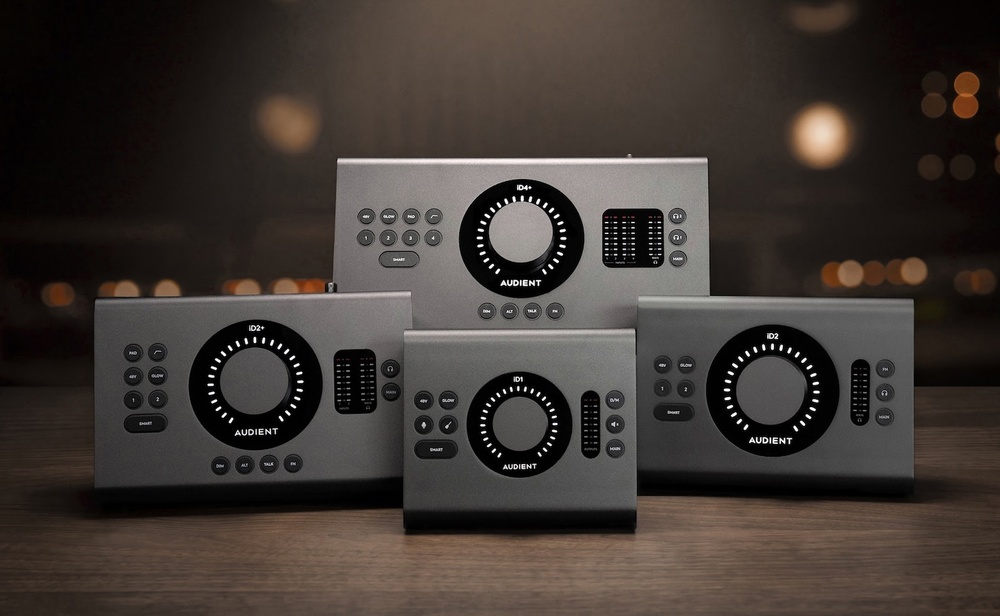
Four models, one platform. The range replaces Audient’s older iD lineup entirely, with every unit stepping up in meaningful ways. Here’s the breakdown at a glance:
| Model | I/O | Preamps | Highlights | Price (USD) |
|---|---|---|---|---|
| iD1 | 2-in / 2-out | 1 mic + JFET instrument | Entry-level, bus-powered via USB-C | $199 |
| iD2 | 10-in / 6-out | 2 mic preamps + ADAT | Dual monitor outputs, Pro Monitor Control | $299 |
| iD2+ | 10-in / 14-out | 2 mic preamps | Hardware inserts, 8ch ADAT, RM1 mic included | $499 |
| iD4+ | 20-in / 24-out | 4 mic preamps + 2 JFET | Dual headphone amps, 16ch ADAT, RM1 included | $699 |
| All models: 32-bit / 192kHz · 128dB dynamic range · USB-C bus power · Mac & Windows | ||||
The Feature Nobody Expected: RoomTune
Room correction software like Sonarworks or IK Multimedia’s ARC has existed for years, but it always runs as a plugin — eating CPU, adding latency, and costing extra on top of your interface. Audient’s RoomTune is different. It runs entirely on the interface’s onboard DSP chip, works system-wide at zero latency, and — crucially — costs nothing extra. It’s baked in, free, and doesn’t touch your CPU.
“Room correction built into the hardware, with no subscription, no plugin, no CPU hit. That’s not marketing. That’s genuinely useful.”
Studio Gear Experts
You’ll need the RM1 reference microphone to calibrate it. The iD2+ and iD4+ include the RM1 in the box. For the iD1 and iD2, it’s an extra $54.99 — worth factoring into your true cost, but still remarkably affordable for what you get. If you want to understand why room correction matters for mixing, our guide on choosing the best audio interface covers how your room affects every decision you make at the mixing desk.
What Audient Isn’t Telling You
At launch, RoomTune only corrects the main stereo monitor outputs. Headphone correction is planned but not live yet. And the system-wide correction means it’s always on — there’s no easy bypass built into the DAW chain. For most home producers, this is fine. For anyone doing mastering work where you need to A/B your room constantly, it’s worth noting.
The Analogue Tone Suite — Not Just a Gimmick
Beyond the room correction, every iD Mk3 comes loaded with a hardware Analogue Tone Suite. This isn’t software emulation — it’s real analogue circuitry baked into the signal path. Four tools: Orbit (variable impedance, changing how your mic “sees” the preamp), HMX (harmonic saturation via a custom MOSFET circuit), LIFT (a high-frequency presence boost), and GLOW (HMX + LIFT combined). It’s the kind of colour-shaping that used to require outboard gear. These preamps are the same Class-A design from Audient’s ASP8024-HE console, with 75dB of clean gain on tap. If you’ve been recording through a Focusrite Scarlett Solo and wondering why your vocals feel a bit lifeless, this is the upgrade you’ve been waiting for. If you’re already on a UA Apollo or an RME Babyface Pro, the difference will be more subtle.
SmartGain returns from the EVO range — it automatically sets your input levels so you’re not guessing at gain staging. For podcasters and content creators plugging in a condenser microphone for the first time, this alone removes a genuinely frustrating friction point. Want to know more about how gain staging fits into the bigger recording picture? Check out our explainer on what an audio interface actually does.
The Real-World Comparison
The Focusrite Scarlett 2i2 (4th Gen) is still the default recommendation at the entry level — it’s cheaper, it’s everywhere, and it works. But it has no onboard DSP, no tone-shaping, and no room correction. At $299, the Audient iD2 isn’t competing with the 2i2 on price — it’s competing on capability. And right now, nothing else at $299 ships with free, hardware-accelerated room correction built in.
At the other end, the Universal Audio Volt 476 hits a similar market to the iD4+ at a lower price point, but UA’s ecosystem is built around their plugins and Luna DAW. If you’re not already in that world, the iD4+’s hardware-first approach is arguably more versatile. For more on how these interfaces stack up in a home recording environment, see our home recording setup guide and our roundup of the best studio headphones to pair with any new interface.
Who Should Actually Buy This?
✓ Buy This If…
- You’re upgrading from a Scarlett Solo or any first-generation interface
- Your mixes sound different on headphones vs. speakers and you can’t figure out why
- You want analogue character without buying outboard gear
- You record podcasts, vocals, or acoustic instruments at home
- You want room correction without a monthly subscription
- You’re a content creator who wants set-and-forget gain staging
✗ Skip This If…
- You already own an RME Babyface Pro — the jump is incremental
- You’re deep in the Universal Audio ecosystem and need UA plugin access
- You need more than 4 mic preamps in a small form factor
- You’re a mastering engineer who needs constant A/B on room correction
- Your budget is under $200 and you just need something that works
The Bottom Line on the Audient iD Mk3
The Audient iD Mk3 isn’t just a spec bump — it’s a rethink of what a desktop interface should do in 2026. Room correction without the tax of a plugin subscription, real analogue tone-shaping at every price tier, and the kind of preamp quality that used to cost twice as much. The iD2 at $299 is the sweet spot for most home studio builders. The iD4+ at $699 is a serious professional tool. Either way, Audient just made the competition’s value proposition a lot harder to defend. For a full picture of everything you need to build around this interface, check out our recording studio equipment checklist and our guides to the best condenser microphones and best budget studio monitors to complete your setup.
Does the Audient iD Mk3 look like the real deal to you, or is Audient asking too much for a room correction feature that’s still limited at launch? Let us know in the comments below.