

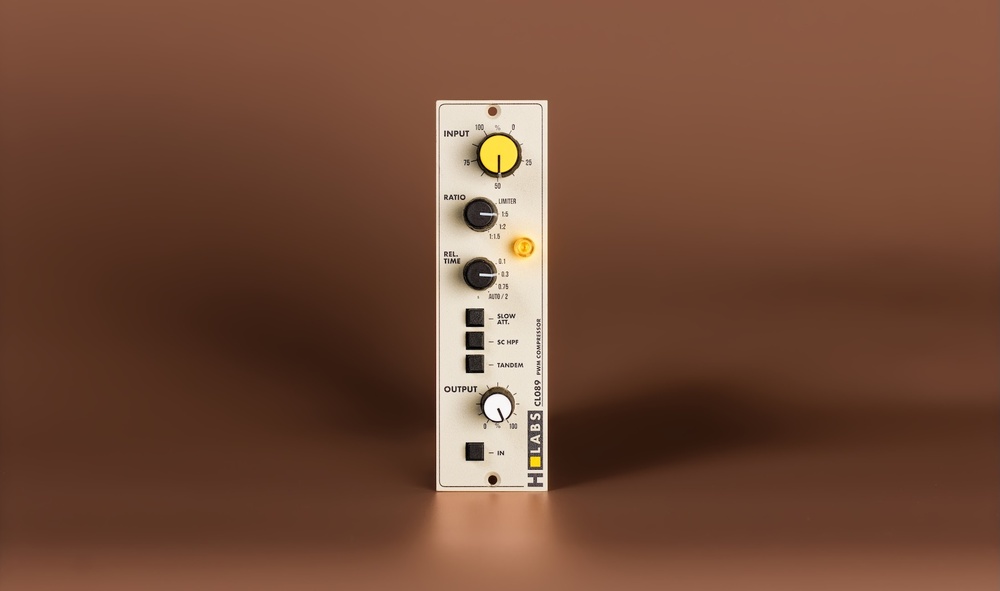
Finding a 500-series compressor with genuine vintage DNA — not just marketing copy about “classic warmth” — is harder than it sounds. Most of what’s out there is either too clean to have any personality, or so coloured it fights every mix you put it in. The HLabs CL089 changes that conversation entirely. This is a pulse-width modulation compressor pulled straight from the Studer 089 console of the late 1960s, rebuilt for your 500-series rack right now. And the verdict? If you care about how compression actually feels on a track, this one deserves your full attention.
Where This Circuit Comes From
HLabs is a small French manufacturer based in Lyon, and they have one obsession: the Studer console legacy. They’ve already given us the PRE169 and EQ169 — both drawn from the Studer 169 console used in professional broadcast and classical recording. The CL089 goes deeper. It resurrects the compressor/limiter section from the Studer 089, a 1968 Swiss broadcast console that used a genuinely unusual gain-reduction method.
That method is PWM — pulse-width modulation. While most hardware compressors use VCA, optical, or tube-based gain reduction, the 089 controlled dynamics by switching the signal path at high speed. It’s why the original console sounded so distinctive. HLabs says they’ve stayed “remarkably close to the original Studer circuitry” — and given their track record with the PRE169, that claim holds weight.
Worth knowing: HLabs notes that “transparent” meant something different in 1968. The CL089 isn’t invisible — it has character. If you’re looking for a totally neutral compressor, look elsewhere. If you want a compressor that does something to a sound, read on.
Specs at a Glance
| Feature | Detail |
| Format | 500 Series module (single-slot) |
| Gain Reduction | Pulse-Width Modulation (PWM) |
| Ratios | 1.5:1 · 2:1 · 5:1 · LIMIT |
| Release | 5 settings including AUTO |
| Attack | Standard + Slow mode |
| Sidechain HPF | 120 Hz (switchable) |
| Stereo | TANDEM link (two units) |
| Output Stage | H101 discrete op-amp + Lundahl LL1588 transformer |
| Metering | Incandescent gain-reduction lamp |
| Swappable Op-Amp | Yes — socketed, 2520-compatible |
| Construction | ~99% through-hole, hand-built in France |
| Price | $1,059 / £830 incl. VAT / €949 |
What HLabs Isn’t Telling You
No measured specs. The KMR Audio product page lists zero technical figures — no THD, no noise floor, no frequency response numbers. For a module at this price, that’s notable. HLabs is leaning on heritage and circuit philosophy rather than test bench results, which works for enthusiasts but leaves engineers without data to compare against.
The incandescent lamp metering is also worth scrutinising. It’s a brightness-based gain reduction display — evocative, yes, but imprecise by design. HLabs admits it “probably isn’t necessary,” which is an unusual thing to say about your own product. It tells you compression is happening, not how much. If accurate metering matters to your workflow, factor that in.
There’s also no information yet on stereo TANDEM tracking accuracy. Two units linked for stereo compression is only as good as channel-to-channel consistency, and without published figures or a production run with significant user feedback, that’s still an open question.
How It Compares to What’s Already on Your Shelf
If you already own an SSL G-Comp or a 500-series API 525, the CL089 won’t replace either of those for surgical mix-bus compression. Those units give you precision; this one gives you character. Think of it less as a competitor to the SSL and more as a flavour source — the kind you reach for when a track needs something you can’t quite name.
If you’re still running a budget-tier VCA compressor and wondering why your acoustic recordings or vocals sound “processed” rather than “controlled,” the CL089’s PWM circuit and transformer output will show you what that missing dimension actually is. It’s the kind of upgrade that changes how you think about dynamics — not just what numbers you’re hitting.
Who Should Actually Buy This?
—✓ Buy This If…
- You already have a solid 500-series rack and want a flavour compressor with real vintage DNA
- You record acoustic instruments, voice, or anything where “air” and dimension matter
- You want an op-amp-swappable unit you can personalise over time
- You’re building a Studer-inspired studio signal chain around the PRE169 and EQ169
- You want a conversation piece that actually sounds great
✗ Skip This If…
- You need a mix-bus compressor with precise, readable metering
- You already own a Neve 33609 or high-end VCA and want lateral movement
- Detailed published specs are essential to your buying process
- Your budget is better spent on a solid audio interface upgrade first
- You need verified stereo performance from day one
The Bottom Line on the HLabs CL089
The HLabs CL089 is proof that the most interesting audio compressor designs aren’t always the most famous ones. The Studer 089 console sat in Swiss broadcast studios for decades, quietly doing things with dynamics that no one else was doing — and now that circuit lives in a 500-series module you can actually buy. At $1,059, this isn’t an impulse purchase. But for the right engineer, with the right rack, this is exactly the kind of tool that makes you excited to hit record.
→ View the HLabs CL089 on hlabs.audioDoes the HLabs CL089 earn a spot in your 500-series rack? Is the PWM approach enough to justify the price over a proven VCA design — or is the lack of published specs a dealbreaker for you? Drop your take in the comments below.


