Our verdict up front: this is not hype. The TK-Lizer 3 is a genuinely compelling upgrade over its predecessor, targeted squarely at engineers and producers who want smooth, recallable analog tone shaping without patching in a separate M/S encoder. But — and this is a real but — at $1,899, it’s not for everyone. Let’s break it all down.
What Exactly Is the TK Audio TK-Lizer 3?
Think of EQ as seasoning. A corrective EQ is like salt — you add it where something’s wrong. A Baxandall EQ is like a finishing oil — it makes everything taste more like itself, only better. That’s the philosophy behind TK Audio’s approach since their original TK-Lizer dropped over a decade ago.
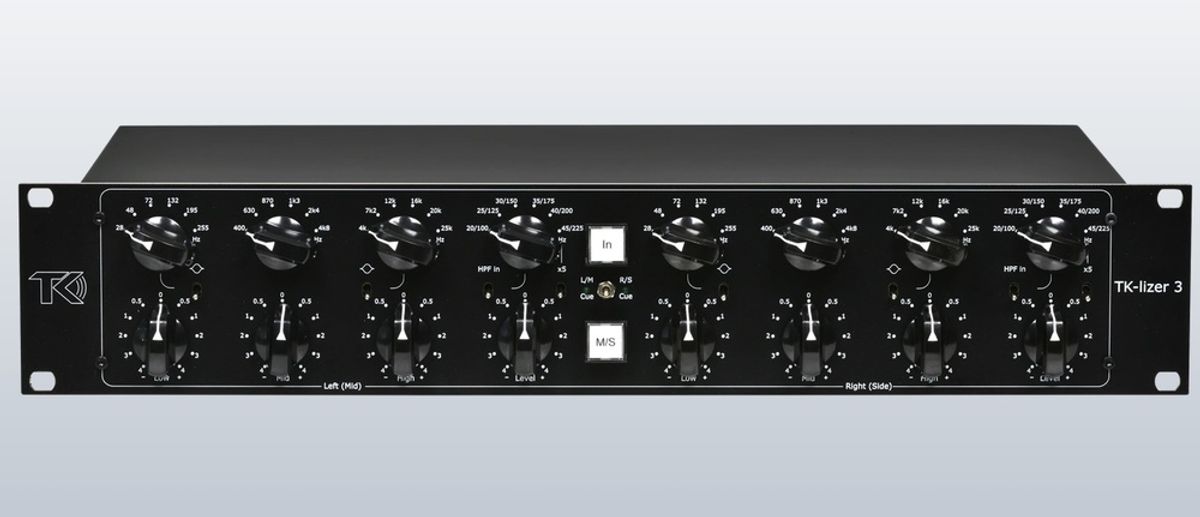
The TK-Lizer 3 is a 19-inch rack unit built around the classic Baxandall circuit topology — a design from the 1950s that engineers still swear by for its exceptionally broad, natural shelving curves and smooth phase behaviour. It’s the kind of EQ that makes your mix bus breathe rather than fight. It gives you three bands across the full frequency spectrum, a dedicated high-pass filter section, full onboard Mid/Side processing, and fully stepped controls for dead-accurate session recall. If that last part doesn’t excite you, ask yourself: how many times have you come back to a session and couldn’t recreate your exact hardware settings?
It replaces the discontinued TK-Lizer 2, bringing several under-the-hood upgrades while keeping the core philosophy intact. And if you’re building out your home studio chain, it’s worth reading our guide to pro recording studio equipment essentials before deciding if a hardware mastering EQ belongs in your signal path right now.
The Specs — No Fluff, Just the Numbers
Here’s everything you need to know at a glance:
TK Audio TK-Lizer 3 — Quick Spec Sheet
| Feature | Detail |
|---|---|
| EQ Topology | 3-band Baxandall-inspired (Low, Mid, High) |
| Gain per Band | ±4 dB / 6 selectable frequencies per band |
| Low & High Bands | Switchable between shelf and peak modes |
| Mid Band | Fixed peak filter |
| High-Pass Filter | 12 selectable frequencies, 12 dB/oct slope, ×5 multiplier |
| M/S Processing | Full onboard Mid/Side encoder + decoder (>60 dB separation) |
| Cue Function | Monitor L, R, Mid, or Side in isolation |
| THD+N @ 0 dBu | 0.0004% — essentially inaudible |
| Dynamic Range | 123 dB |
| Frequency Response | 20 Hz – 80 kHz, ±0.1 dB |
| Signal Path | Electronically balanced, no electrolytic capacitors |
| Controls | Fully stepped — vintage bakelite knobs & toggle switches |
| Price | $1,899 USD / £1,619 / €1,859 |
What Actually Changed from the TK-Lizer 2?
TK Audio didn’t just slap new knobs on the old unit and call it a day — though the knobs are genuinely beautiful. Those vintage bakelite tactile controls paired with proper toggle switches give the front panel a look that’ll stop any gear photographer in their tracks.
But underneath the aesthetic refresh, the real story is in the circuitry. TK Audio rebuilt the input and output stages from the ground up. They reworked the high and low frequency band circuits for extended reach — that 20 Hz to 80 kHz frequency response tells you there’s serious headroom at both extremes. Most importantly, they upgraded the M/S encoder/decoder matrix, pushing channel separation past 60 dB. In practical terms? Cleaner, more defined Mid/Side processing with far less crosstalk blurring between your centre image and your stereo sides.
The TK-Lizer 2 is now discontinued. If you’re currently eyeing a used unit online, factor in that the new version is a meaningful technical leap, not just a cosmetic one.
What the Press Release Doesn’t Tell You
Every gear announcement reads like a love letter. Here’s what we’re watching more carefully.
No Low-Pass Filter
This has been the single loudest complaint about every TK-Lizer going back to the original. The Dangerous Music Bax EQ — the most direct hardware competitor at roughly double the price — includes a low-pass filter. The TK-Lizer 3 does not. If you regularly need to trim your high end on the master bus, you’ll need a separate tool for that, or you’ll be reaching for a plugin to finish the job.
The ±4 dB Ceiling
Each band gives you just ±4 dB of gain. For mastering-style work across a full mix, that’s actually ideal — subtle moves are the name of the game here. But if you’re hoping to use this as a corrective workhorse on individual tracks with problem frequencies, you’ll hit that ceiling fast. This is a finishing EQ through and through, not a Swiss Army knife.
The Mid Band Is Fixed Peak — No Shelf Option
While the low and high bands let you toggle between shelf and peak modes, the midrange is locked to a fixed peak filter. That’s deliberate — Baxandall-style mids work beautifully as peaks. But if you wanted shelving control in the midrange, you won’t find it here.
No Automation or Recall Beyond Stepped Knobs
The stepped controls are a brilliant solution for session recall — write down your knob positions and you’re good. But there’s no MIDI, no CV, no digital recall integration whatsoever. In a hybrid studio, you’re doing this the analogue way: pen, paper, and discipline.
TK-Lizer 3 vs. the Competition: Who Wins?
The most obvious rival is the Dangerous Music Bax EQ. It’s the benchmark Baxandall hardware EQ, beloved by mastering engineers worldwide. Here’s how they actually stack up:
TK Audio TK-Lizer 3
- ✅ $1,899 — significantly more affordable
- ✅ Built-in M/S — no separate encoder needed
- ✅ Cue for L / R / Mid / Side isolation
- ✅ Extended HPF with ×5 multiplier
- ✅ Side level control for stereo width
- ❌ No low-pass filter
- ❌ ±4 dB gain limit per band
- ❌ No digital recall integration
Dangerous Music Bax EQ
- ✅ Low-pass filter included
- ✅ Wider frequency point options
- ✅ Legendary studio pedigree
- ✅ Higher per-band gain range
- ❌ ~$3,500+ USD — nearly double the cost
- ❌ No built-in M/S — requires external matrix
- ❌ Adds cost and patch complexity for M/S work
- ❌ Fewer stereo imaging tools built in
The bottom line is this: if you already own the Dangerous Music Bax EQ, the TK-Lizer 3 won’t change your life. But if you’re still running a software-only mix bus and dreaming of your first quality outboard EQ, the TK-Lizer 3 is the upgrade you’ve been waiting for. It packs more stereo imaging tools into one box than the Bax does — at half the price.
The M/S Feature: Why It Matters More Than You Think
Mid/Side processing used to be the exclusive domain of mastering engineers with racks full of outboard gear and dedicated M/S matrix boxes. It’s a technique where instead of processing the left and right channels separately, you split the signal into what’s in the centre (the “Mid”) and what’s panned to the edges (the “Side”) — then treat them independently.
Why does this matter? Picture a mix where the kick and bass feel a little woolly. You can high-pass just the Mid channel to tighten up the centre without touching the warm pads you have rolling across the sides. Or your mix sounds slightly narrow — lift a touch of 10 kHz on the Side channel only, and suddenly your stereo field opens up without brightening the vocal sitting in the middle. This is surgical control that sounds completely natural.
The TK-Lizer 3 handles all of this without a single extra cable. Switch to M/S mode, select which channel you’re working on, dial in your correction, use the cue function to solo and verify — and you’re done. That built-in cue for auditing L, R, Mid, or Side in isolation? An underrated time-saver.
💡 Pro Tip: M/S and Your HPF
Use the high-pass filter in M/S mode to mono your sub-bass frequencies below 80–100 Hz on just the Side channel. This keeps your kick and bass locked tight in mono (critical for club and vinyl compatibility) while leaving your full stereo width intact at mid and high frequencies. It’s one of the most used moves in professional mastering — and the TK-Lizer 3 does it natively.
The Baxandall Circuit: Why Engineers Have Trusted It Since the ’50s
Ever wondered why your EQ boosts sometimes sound harsh or phasey, while other times they sound invisible? The circuit design is usually the answer. Peter Baxandall developed his equaliser topology back in 1952, and it became the gold standard for hi-fi and broadcast tone controls almost immediately — because it’s inherently musical.
Unlike parametric or graphic EQs that cut through a frequency with a scalpel, a Baxandall EQ works in broad, gentle shelves and bell curves. You’re not removing frequencies — you’re tilting the tonal balance. It’s the reason that a half-dB boost on the high shelf sounds like your mix just got turned up, rather than like someone cranked the treble.
Combined with TK Audio’s electronically balanced signal path and the complete absence of electrolytic capacitors in the audio path, you get a unit that measures about as clean as it gets — 0.0004% THD at 0 dBu and a dynamic range of 123 dB. That’s not a typo. It’s genuinely exceptional for analogue hardware at this price.
The High-Pass Filter: More Versatile Than It Looks
Most hardware EQs at this price give you a basic HPF — a few fixed frequencies, a single slope, and that’s it. The TK-Lizer 3 gives you 12 selectable frequencies and a ×5 multiplier that extends your reach far into the upper range. The 12 dB/octave slope is gentle enough not to smear transients, and the carefully tuned Q keeps it musical rather than clinical.
In practice, this means you can clean up low-end rumble on a full mix, tighten up a stem that’s accumulating mud below 40 Hz, or — in M/S mode — lock the bass entirely into mono for a solid, phase-coherent low end. That last use case alone is worth the price of admission for engineers working on music that needs to translate to club systems.
Real-World Applications: Where Does It Actually Shine?
🎛 Mastering Chain
Broad tonal shaping on the 2-bus. A touch of low-end warmth, a hint of high-end air — and the stepped controls mean you can recall it exactly next session.
🎚 Mix Bus Finishing
Use it in stereo mode to enhance the overall tonal character of a mix before it hits your limiter. Natural, transparent, and forgiving on busy mixes.