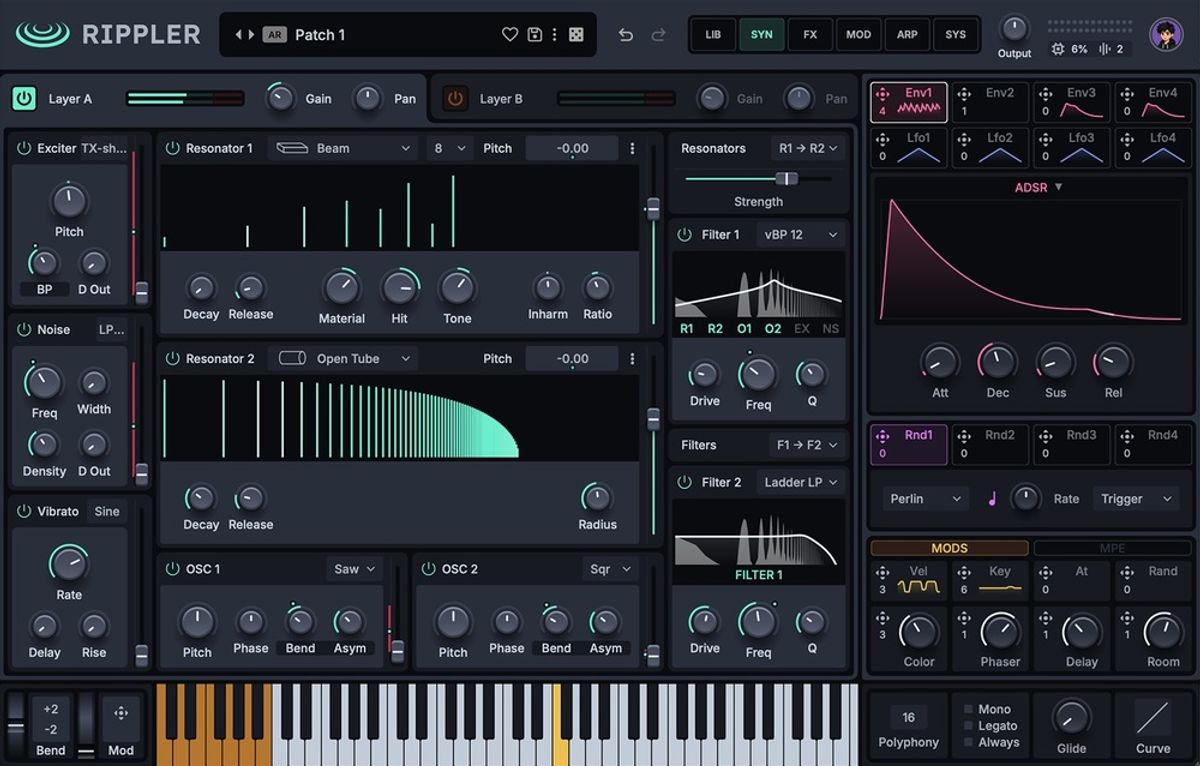
Physical modeling synthesis has been a secret weapon hiding in plain sight. Composers and sound designers know it. Bedroom producers? Most haven’t touched it — because the market has barely given them a reason to. That changed on July 30, 2026. ReFX Rippler just launched, and it’s the most significant physical modeling synth plugin to arrive in years. The immediate verdict: exceptional depth, a surprisingly clean interface, and at $99 introductory pricing, one of the most compelling plugin releases of 2026.
By the Numbers: What’s Actually Inside
Skip the press release language. Here’s the full picture at a glance.
| Feature | What You Get |
|---|---|
| Format | VST3, AU, AAX — Mac & Windows |
| Price | $99 intro / $129 regular |
| Resonator Models | 12 (String, Bell, Membrane, Djembe, Vibraphone, Marimba + more) |
| Filter Types | 27 — vintage, ladder, comb, vowel, and more |
| Layers | 2 (each with 2 exciters, 2 resonators, 2 oscillators, 2 filters) |
| Modulation | 4 envelopes, 4 LFOs, 4 randomizers, MPE support, 4 macros |
| Effects | 12 effects per layer + global (granular, tape emulation, BBD delay, reverb) |
| Factory Presets | 400+ |
| Install Size | ~51 MB |
| Trial | 30-day free trial available |
What the Press Release Didn’t Tell You
The marketing is clean and confident — but here’s the stuff reFX buries in the footnotes. Rippler cannot play two completely independent sounds simultaneously. Each patch is a single sound. You can’t split the keyboard or stack two separate patches the way AAS Chromaphone 3 can. For live performers, that’s a real limitation worth knowing before you buy.
Activation requires the reFX Cloud app with mandatory online registration — no offline option exists. If your studio setup involves air-gapped machines or you simply hate cloud dependency, expect friction. There’s also no standalone mode — you need a DAW running to host the plugin every single time. And Linux users who loved the original open-source version? Left behind entirely.
Rippler vs. AAS Chromaphone 3: The Honest Comparison
If you’re already deep in Chromaphone 3, Rippler won’t make you abandon it overnight — but it will make you reach for it less. If you’re still relying on stock DAW instruments for acoustic textures, this is the upgrade you didn’t know you were waiting for.
Chromaphone 3 still wins on true bi-timbral performance — two separate, split, or stacked sounds is something Rippler genuinely can’t do. But Rippler wins almost everywhere else. Four additional resonator types. A hybrid virtual analog engine with dual oscillators that opens the door to fat basses, punchy leads, and lush pads — territory Chromaphone never entered. The modulation engine is simply deeper, with drawable LFO shapes and full MPE implementation.
Hook up a capable MIDI keyboard controller with MPE support and Rippler responds to pressure, pitch bend, and slide on every individual note — independently. That kind of expressiveness used to belong to hardware alone.
Who Should Actually Buy This?
✅ Buy This If…
- You score films, games, or produce cinematic and ambient music
- You want physical modeling and subtractive synthesis in one plugin
- You’re relying on stock DAW instruments for acoustic sounds
- You want 400+ production-ready presets on launch day
- You use Mac or Windows and $99 fits the budget
❌ Skip This If…
- You need true bi-timbral layering for live or studio performance
- Offline activation is non-negotiable for your workflow
- You’re on Linux
- You already own Chromaphone 3 and love it for bi-timbral work
- You need a standalone plugin with no DAW required
The bottom line is straightforward: ReFX Rippler is the physical modeling synth plugin the market has quietly needed for years. A genuine hybrid engine, a beautiful UI, a deep modulation system, and 400 presets ready to fire from day one. The mandatory cloud activation and the lack of true bi-timbral support are real gotchas — not dealbreakers for most, but worth knowing upfront. At $99 introductory pricing, the value-to-depth ratio is hard to argue with. Does Rippler look like the Chromaphone killer to you, or does the bi-timbral gap leave you cold? Drop your thoughts in the comments below.