The 500 Series market is crowded. Every brand with a soldering iron has squeezed a compressor into the lunchbox format and called it a day. Most of them? Fine. Forgettable. Just another box to fill a rack slot.
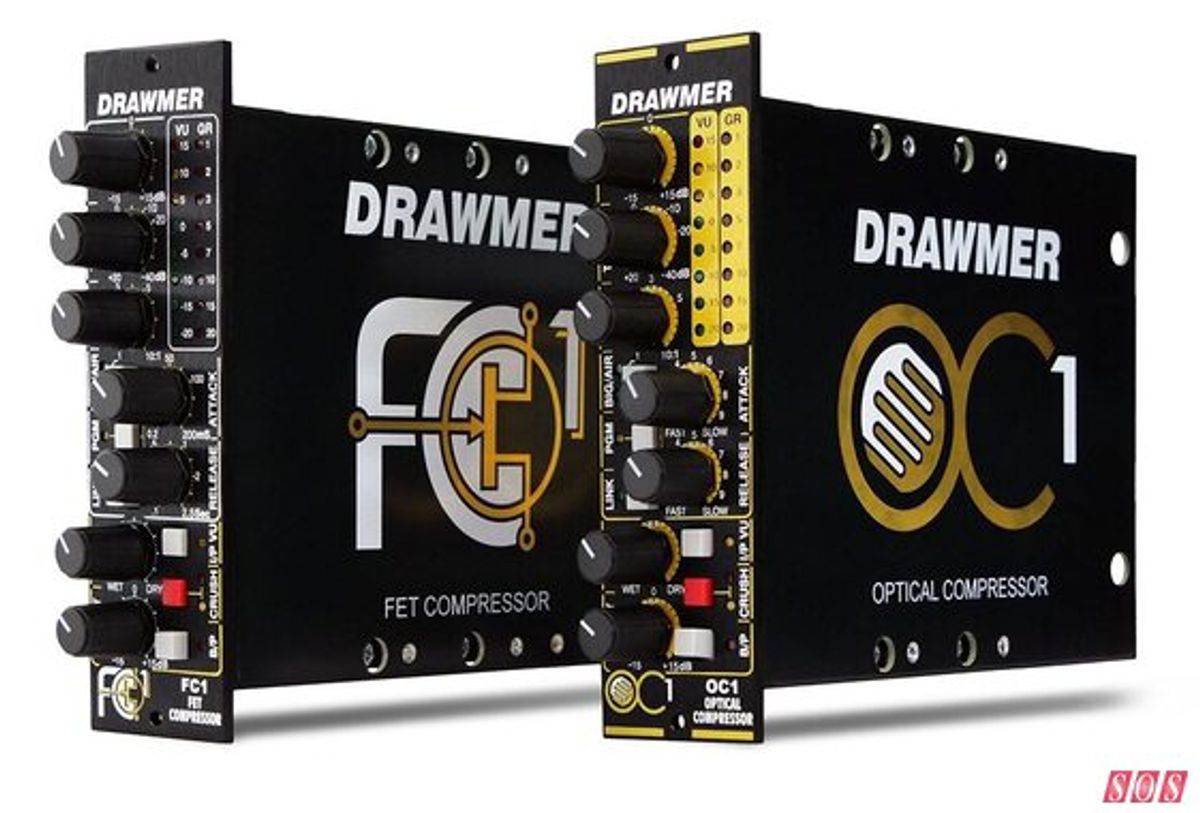
Then Drawmer shows up with not one but two new modules — the Drawmer OC1 & FC1 Compressors — and suddenly the conversation gets a lot more interesting. These aren’t badge plays. They’re not clones. They’re two distinctly engineered, brilliantly executed takes on compression from one of the UK’s most respected dynamics manufacturers, and they’ve just landed at a price that makes them accessible without making you feel like you compromised.
Here’s the upfront verdict: both are excellent. But they’re excellent in very different ways — and buying the wrong one for your workflow will leave you frustrated. Let’s break down exactly what each unit does, who it’s built for, and where the press release quietly glosses over the details you actually need to know.
⚡ TL;DR — Quick Verdict: The OC1 is smooth, warm, and musical — built for vocals, acoustic instruments, and anything that needs to breathe. The FC1 is fast, punchy, and aggressive — built for drums, electric guitar, and transient-heavy sources. Both are genuinely pro-grade at a hybrid-studio price. If you can only grab one, match the compressor type to your most-recorded source.
Spec Breakdown at a Glance
Rather than wade through the press release, here’s everything that matters — laid out so you can scan it in 30 seconds.
| Feature | OC1 — Optical | FC1 — FET |
|---|---|---|
| Compression Type | Optical (Opto) | FET (based on 1970s Series) |
| Sonic Character | Warm, smooth, musical | Fast, punchy, aggressive |
| Sweet Spot | Vocals, acoustic guitar, bass, piano | Drums, electric guitar, energetic vocals |
| Input / Output Gain | −15 to +15 dB | −15 to +15 dB |
| Threshold Range | +20 to −40 dB | +20 to −40 dB |
| Ratio | 1:1 to 10:1 | 1:1 to 10:1 |
| BIG Mode | ✓ | ✓ |
| AIR Mode | ✓ | ✓ |
| CRUSH Circuit | ✓ | ✓ |
| PGM (Programme) Mode | ✓ | ✓ |
| Mix / Parallel Compression | ✓ | ✓ |
| Stepped Controls | 21-position detented | 21-position detented |
| Stereo Link | ✓ (via 500 Link pin) | ✓ (via 500 Link pin) |
| Bypass | Hard-wire | Hard-wire |
| Format | 500 Series — single slot | 500 Series — single slot |
| Price | £290 + VAT (£348 inc.) | £290 + VAT (£348 inc.) |
| Origin | Handcrafted in the UK | Handcrafted in the UK |
Two Flavours. One Decision.
Here’s the first thing you need to understand: the OC1 and FC1 aren’t competing with each other. They’re designed to complement each other. Think of them as the yin and yang of Drawmer’s 500 Series range.
OC1 — The Smooth One
This is Drawmer’s first-ever optical compressor. That’s a genuine milestone. Optical compression works through a photocell circuit that responds gradually to audio — the result is natural-sounding gain reduction that feels musical rather than mechanical. It breathes. It enhances. It’s the kind of compressor that makes vocalists sound better without making it obvious that anything happened.
FC1 — The Punchy One
The FC1 draws from the FET circuit in Drawmer’s acclaimed 1970s rack series. FET compressors are the street-fighter version of dynamics control — fast, decisive, and full of character. Drums love them. Electric guitars love them. Anything that needs to shove its way to the front of a mix loves them. This is a compressor that adds attitude, not just control.
Both units share an identical control layout and feature set — which is an interesting design decision. You get the same BIG mode, AIR mode, CRUSH circuit, PGM switch, Mix knob, and 21-position stepped controls on each. The circuit underneath is different; the tools you have to work with are the same. It means the learning curve is short, and switching between sessions is seamless.
What Drawmer Didn’t Put in the Press Release
Every piece of gear has the story the manufacturer tells, and then there’s the version that matters in the real world. Here’s what deserves more than a footnote.
No Sidechain Filter
Both units are comprehensive in almost every way — but there’s no dedicated sidechain EQ or high-pass filter built into the detector circuit. For engineers who use frequency-dependent compression for de-essing, managing low-end pumping, or applying ducking effects, this is a gap worth acknowledging. The PGM mode does help with programme-dependent pumping (more on that below), but it’s not a substitute for a proper sidechain filter. You’ll need an external EQ before the unit, or a DAW plugin on the input path, if this workflow matters to you.
Is it a dealbreaker? Not for most people. The classic LA-2A has two knobs and has been used on more hit records than we can count. But it’s worth knowing before you commit.
You Need a 500 Series Chassis
This one sounds obvious, but it catches people off guard more often than it should. These are single-slot 500 Series modules. They do not include a chassis. They need a 500 Series lunchbox to provide power and audio connectivity. A quality chassis — from brands like API, Radial, or Cranborne — runs from roughly £150 to £400 depending on the number of slots and onboard features. If you’re building from scratch, factor that into your total spend. Check out our complete recording studio equipment guide for a full breakdown of what you’ll need alongside gear like this, including interface routing and power considerations for outboard hardware.
Stereo Operation Costs Double
Want stereo compression — say, across a drum bus or a mix bus? You’ll need two units, linked via the 500 Series Link pin. The Link control connects adjacent slots, but there’s no stereo operation inside a single module. Not unusual for the format, but it means a stereo stereo pair lands at £580 + VAT before chassis costs. Worth planning for if this is the use case on your mind.
💡 Pricing Note: At £290 + VAT (£348 inc.) each, these are well-positioned against the competition. You’re getting Drawmer engineering, UK manufacturing, and a full feature set for roughly the same cost as many stripped-down 500 Series alternatives.
The Real-World Comparison: Who Should Actually Be Looking at These?
Let’s get specific, because “great compressor” tells you nothing useful.
If you’re eyeing the Warm Audio WA76 (FET, ~£300), the FC1 is a direct upgrade in feature depth. The WA76 is a competent 1176-style compressor — but it doesn’t have BIG/AIR tonal shaping, CRUSH saturation, PGM release, or a wet/dry Mix knob for parallel compression. If you already own a WA76 and want something with more control and a more specifically British voice, the FC1 is a natural next step.
If you’re comparing to the Heritage Audio ChainA-500 (optical, ~£320), the OC1 competes comfortably on features and arguably pulls ahead on the strength of the CRUSH circuit and those 21-step stepped controls — which matter enormously for session recall. For engineers running repeated client sessions, reliable recall is a professional necessity, not a luxury.
If you already own a Drawmer 1970s rack compressor? The FC1 is essentially that same circuit character in a single-slot 500 format. If you love the 1970s sound but want it in a more modular, travel-friendly setup, the FC1 delivers exactly that.
If you’re running entirely software-based right now with a clean audio interface and want your first piece of genuine analogue outboard, either of these is an excellent entry point. Pair an OC1 with a quality audio interface that has clean line inputs, and you’ve built a hybrid chain that would have cost three times as much a decade ago.
OC1 — Optical
£348
inc. VAT / £290 ex. VAT
FC1 — FET
£348
inc. VAT / £290 ex. VAT
Stereo Pair (2× one unit)
£696
inc. VAT / chassis not included
The Features That Make These Units Worth Your Attention
Here’s where it gets genuinely interesting. The OC1 and FC1 aren’t just different compression circuits in the same box — they’re packed with features you’d normally find only on pricier full-rack units. Let’s go through the ones that actually matter.
Feature 1 BIG & AIR Modes
Think of these as one-click tone enhancement — without touching your EQ. BIG adds density and weight to the low end. It makes the bottom of a vocal track sit fuller. On drums through the FC1, it makes the kick feel like it’s punching through the speakers rather than just touching them. AIR opens up the high frequencies — more shimmer, more presence, without harshness.
Used together, the effect on an acoustic guitar is remarkable. The BIG mode gives the body of the instrument more physical presence. AIR brings out the string detail and pick attack. You get the kind of acoustic tone that normally requires a $3,000 microphone and a very treated room — not just a £348 compressor.
Feature 2 The CRUSH Circuit
This is the hidden gem of both units, and it’s the feature that will make engineers do double-takes during sessions.
CRUSH is a harmonic saturation circuit that responds to your input signal level — the harder you push it, the more harmonic content gets added. It’s not aggressive distortion. It’s the kind of subtle analogue warmth that adds density without mud, life without grit. Use it lightly on an acoustic guitar and it adds woody body. Push it harder on electric bass and it glues the transients together in a way that suddenly makes the low end feel coherent and intentional.
On vocals through the OC1 with CRUSH engaged? It adds just enough analogue colour that the voice stops feeling like a digital recording and starts feeling like something that was tracked through real iron. It’s the kind of difference that’s hard to describe and immediately obvious when you hear it.
Feature 3 PGM Mode — Solving the Pumping Problem
Ever cranked compression on a dense mix and heard that rhythmic rise-and-fall effect — that audible, unnatural “breathing” of the track? That’s pumping. And it’s one of the most common reasons engineers are afraid to push a compressor hard.
PGM mode introduces a second, slower release time that kicks in automatically based on how much programme material is above the threshold. The compressor reads the density of the audio and backs off the release speed before pumping becomes audible. It’s an intelligent, transparent solution. You’ll notice it most when heavy settings stop sounding heavy — which is precisely when it’s doing its job properly.
Feature 4 Parallel Compression via the Mix Knob
The Mix control is a game-changer for anyone working in a hybrid studio. Blend your compressed signal with the uncompressed signal — right on the hardware, without extra routing, without latency juggling in your DAW, without anything except one knob.
Parallel compression used to mean setting up a send bus, routing to a compressed channel, then blending the two. Now it’s a single control. Set heavy compression to get density and body, blend in the dry signal to keep the punch and transient detail, and you’ve got the classic “New York compression” technique built right into the workflow. On drum buses, this is transformative.
Feature 5 21-Position Stepped Controls — The Professional Detail Nobody Talks About
This might be the most underrated feature on either unit. Stepped controls let you reset a compressor to the exact same settings, session after session. Write “Attack: 5, Release: 7, Threshold: −12” on your session notes. Come back six months later. Turn the knobs to those positions. You’re back.
Most 500 Series compressors at this price point use smooth, free-spinning pots. Accurate recall is guesswork — you’re eyeballing a position and hoping. With the OC1 and FC1, session recall is exact. For producers who track across multiple sessions, for engineers who deliver ongoing revision work to clients, for anyone who has ever mixed a track, loved the compression, and then couldn’t recreate it — those 21 steps are a genuinely professional feature.
Who Should Actually Buy This?
Let’s cut to it. Here’s the honest breakdown.
✅ Buy the OC1 if…
- You record vocals as your primary source and want compression that enhances instead of squashes
- You work with acoustic guitar, piano, or orchestral instruments that need smooth, natural dynamic control
- You want Drawmer’s first opto circuit — this is a historically significant product for the brand
- You prefer compression that feels transparent and musical over fast and aggressive
- You value precise recall and need stepped controls for repeated client sessions
✅ Buy the FC1 if…
- You primarily record drums, bass, or electric guitars and need compression that adds punch
- You love the Drawmer 1970s rack sound and want it in 500 Series form
- You want a FET compressor with more features than the Warm Audio WA76 at a similar price
- You use the CRUSH circuit to add harmonic saturation to transient-heavy sources
- You want fast attack and release times without giving up tonal shaping tools
✕ Skip both if…
- You have no 500 Series chassis and no near-term plan to buy one — the entry cost rises significantly
- You need a sidechain filter or frequency-dependent compression built into the unit itself
- You already own a Drawmer 1970s rack compressor and don’t need the 500 format — you’re not gaining new sonic ground with the FC1
- Your budget is under £500 total — accounting for a chassis plus the module will push you over unless you already have the rack sorted
Final Verdict
The Drawmer OC1 & FC1 Compressors are exactly what the 500 Series market needed in 2026: two thoroughly featured, clearly differentiated analogue dynamics tools from a UK manufacturer that’s been at this for decades. Drawmer didn’t chase a trend. They didn’t release another 1176 clone or a me-too opto. They built something with their own DNA — and then they packed it with every feature a working engineer actually uses.
The CRUSH circuit alone makes these worth serious consideration. The stepped controls lift them to professional standard. The BIG, AIR, and PGM modes make them genuinely versatile across a wide range of sources. And the parallel compression Mix knob means you can do in one box what used to require additional routing and hardware.
At £290 + VAT each, these are not impulse purchases. But they are genuinely excellent value for what you’re getting — UK engineering, full feature sets, and a level of build quality that punches well above the price tag. In a crowded lunchbox market, the Drawmer OC1 & FC1 Compressors are the rare new releases that actually earn the attention.
💬 Over to You
Do the Drawmer OC1 & FC1 Compressors look like a winner for your setup, or is the price tag still a stretch for where your studio is right now? Are you Team Opto, Team FET — or are you grabbing both? Drop your thoughts in the comments below. We read every one.