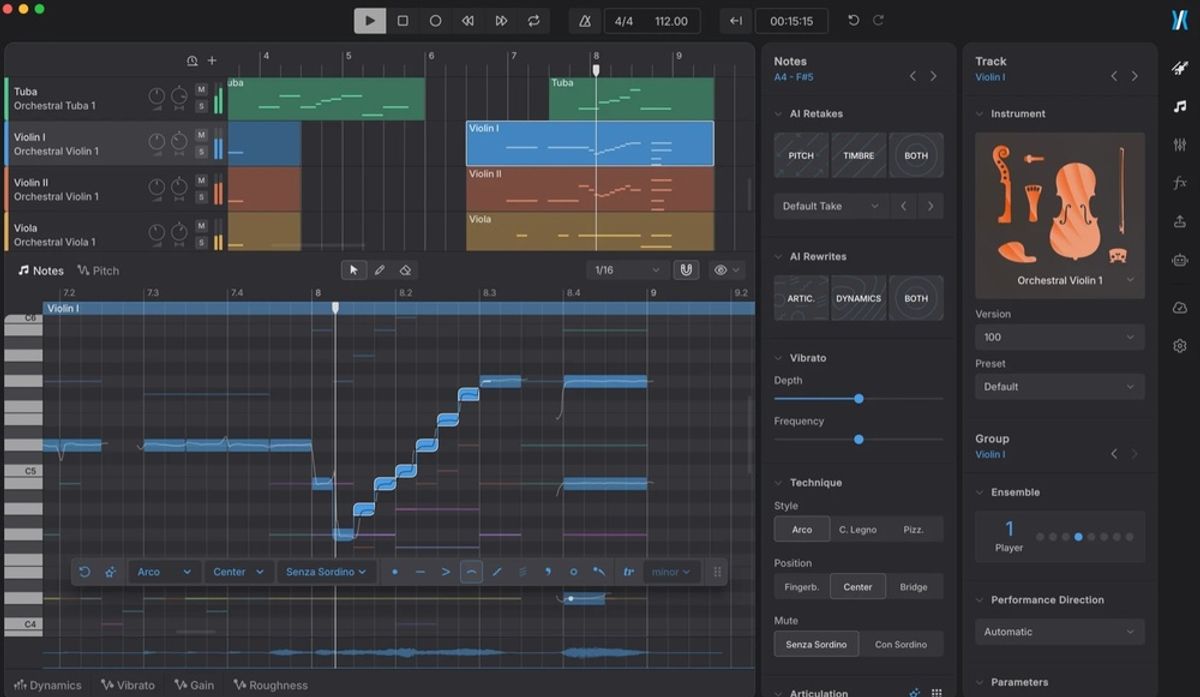
Every orchestral composer has hit the same wall. You load a strings library, hunt for the right keyswitch, nudge velocity curves for twenty minutes, and the result still sounds like a robot playing a violin. Dreamtonics’ Instrument X just arrived — and it’s the most serious challenge to traditional sample libraries we’ve seen in years. Verdict up front: this is genuinely exciting technology, and if you’re still wrangling with multi-gigabyte sample packs, it deserves your full attention.
What Is Instrument X, Actually?
Dreamtonics built their reputation on Synthesizer V — AI-driven vocal synthesis that genuinely turned heads. Instrument X is their move into orchestral territory, and they’ve taken the same neural modeling approach. Instead of playing back recordings of real instruments, the engine models how acoustic sound radiates from a violin, a flute, a trumpet — and generates the result in real time.
That’s a fundamentally different architecture. No samples. No keyswitches. Just notation going in and expressive performance coming out.
The Spec Breakdown
| Feature | What It Means for You |
|---|---|
| Neural Acoustic Modeling | No samples — sound is generated, not played back |
| Smart Articulation | Automatic technique switching based on how you play |
| AI Performance Retakes | Generate alternate phrase performances on demand |
| Up to 11 Mic Feeds | Close spot, Decca tree, and room ambience, all mixable |
| Predictive Dynamics Lane | Changes timbre, not just volume — manual override available |
| Advanced Polyphony | Overlapping notes render as independent voices |
| 5 Performance Presets | Adagio, Allegro, con Fuoco, Pop, Ballad — one click |
| 15 Launch Instruments | Strings, woodwinds, brass, and jazz saxophone |
| Formats | Standalone, VST3, AU, AAX — no GPU required |
What the Press Release Doesn’t Tell You
Here’s where we get honest. Dreamtonics talks a lot about “human-level expression” and “natural acoustic radiation” — but the real question is whether the model holds up on complex, fast passages. Neural synthesis is brilliant at legato and expressive playing. Dense staccato runs at 140bpm with divisi strings? That’s where sample libraries traditionally still win.
The 11-mic mixer panel is also intriguing — but maintaining phase coherence across eleven concurrent neural feeds is non-trivial. Dreamtonics uses a patent-pending dodecahedral speaker array measurement system to train their networks, which sounds impressive. Whether that solves the problem in practice, or just manages it elegantly, we’ll only know after serious real-world use. Pair that with a solid audio interface for your home studio and you’ll be in the best position to hear those spatial nuances clearly.
There’s also no mention of update cadence or how often Dreamtonics plans to expand the library. The “Complete Collection 2026” branding is a hint — expect annual editions. Lock-in is a real consideration here.
How Does It Compare to Spitfire and Kontakt Libraries?
Spitfire BBCSO and EastWest Hollywood Orchestral are the benchmarks. Both are elite, both are sample-based, and both require substantial storage — we’re talking 100GB+ for a serious collection. Instrument X’s entire engine runs locally with no GPU and a fraction of that footprint.
If you already own Spitfire BBCSO Professional, Instrument X probably won’t replace it immediately — the sample library has years of refinement and real-world trust behind it. But if you’re currently using entry-level Kontakt libraries or free orchestral packs, this is the upgrade that changes your workflow entirely. No more hunting keyswitches. No more patching together six articulation layers to get one convincing phrase.
It also integrates with Synthesizer V Studio 2 Pro as a DAW plugin — so if you’re already in that ecosystem, the workflow fit is seamless. Speaking of your DAW setup, check out our guide to the best DAW software for music production to make sure your host is ready to get the most from Instrument X.
Who Should Actually Buy This?
✅ Buy This If…
- You’re a film scorer or game composer who needs fast, expressive orchestral mockups
- You’re a bedroom producer tired of bloated sample libraries eating your SSD
- You already use Synthesizer V and want a unified Dreamtonics workflow
- You want to skip the keyswitch learning curve and just play
- You need professional-grade strings, brass, or woodwinds without a $500+ investment upfront ($99 for a single instrument)
❌ Skip This If…
- You already own Spitfire BBCSO Professional or a mature Kontakt collection — the gap is narrower than Dreamtonics implies
- Your workflow demands hyper-specific articulation micromanagement that’s been refined over decades in traditional libraries
- You need guitars, pianos, or percussion — the launch lineup is strings, winds, and brass only
- You’re on a very tight budget — $649 for the full collection is a real commitment. Make sure your studio setup is solid first
Pricing at a Glance
The entry point is smart. A single instrument expansion starts at $99 — and that includes the host engine for free. You can test the concept without committing to the full suite. A 14-day trial of the editor and 7-day expansion trials are available directly inside the software, so there’s no excuse not to hear it first. If you decide to go all in, the Complete Collection 2026 (15 instruments) lands at $649. And if you’re already a Synthesizer V user, cross-product bundles start at $229. To get the most from any software instrument, you’ll want a quality MIDI keyboard controller that can translate your performance expressively into the engine.
🎻 Dreamtonics’ Instrument X is a genuine leap forward for orchestral production — not just a faster sample player, but a rethink of how virtual instruments work. It won’t dethrone elite sample libraries overnight, but it’s the most compelling argument yet that they don’t have to be the only answer. Does Instrument X look like a winner to you, or is the price tag too steep for what’s still an unproven technology? Drop your take in the comments.