As a seasoned studio engineer, I’ve seen my fair share of gear come and go. But one thing remains constant: the quest for that perfect guitar tone. And let me tell you, it’s not just about the six-string and the amp. The unsung hero of your guitar recording setup is often the microphone you use to capture all that sonic goodness.
In this guide, we’ll dive deep into the world of guitar amp microphones and explore the best options. Whether you’re a bedroom rockstar or a pro studio wizard, I’ve got you covered. So, grab your favorite axe, crank up that amp, and let’s find the mic that’ll make your riffs sing!
Why Your Choice of Microphone Matters
Before we jump into the list, let’s talk about why your mic choice is so crucial. You see, different mics have different personalities. Some are like that brutally honest friend who tells it like it is, while others are more like a flattering Instagram filter for your sound. The right mic can make your guitar tone sparkle, while the wrong one might leave it sounding flatter than a week-old soda.
But here’s the kicker: there’s no one-size-fits-all solution. The “best” mic depends on your guitar, your amp, your playing style, and the genre you’re rocking. That’s why we’ll look at a variety of options to suit different needs and budgets.
Types of Microphones for Guitar Amps
Let’s break down the main types of mics you’ll encounter in your guitar recording journey:
- Dynamic Microphones: These are the workhorses of the guitar world. They’re tough, reliable, and can handle high sound pressure levels without breaking a sweat. Think of them as the sturdy boots of the microphone world.
- Condenser Microphones: These are the detail-oriented perfectionists. They capture all the nuances and overtones of your guitar sound. They’re like having a magnifying glass for your tone.
- Ribbon Microphones: The smooth operators of the bunch. They have a warm, natural sound that can tame harsh highs and add a vintage vibe to your recordings. They’re the audio equivalent of a fine whiskey – smooth and full of character.
Now that we’ve got the basics down, let’s dive into our top picks for the best microphones for guitar amps in 2024!
Our Top Picks for Guitar Amp Microphones
Best Dynamic Microphone


6 Best Microphones For Guitar Amps and Cabs
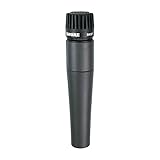
1. Shure SM57-LC Cardioid Dynamic Microphone

Let’s kick things off with a true legend: the Shure SM57. This mic has been around since 1965, and there’s a reason it’s still an industry standard. It’s like the Swiss Army knife of microphones – versatile, reliable, and always gets the job done.
The SM57 is a dynamic microphone with a cardioid polar pattern, which means it’s great at rejecting off-axis sound. This is perfect when you’re in a noisy live setting or a cramped home studio. Its frequency response is tailored for instruments, with a slight presence boost that can add some nice bite to your guitar tone.
What I love about the SM57 is its ability to handle high SPLs (Sound Pressure Levels). You can stick this bad boy right up against your screaming guitar cab, and it won’t even flinch. It’s also incredibly affordable, making it a no-brainer for beginners and pros alike. Just be careful when buying online – there are a lot of fakes out there!
Pros:
- Affordable
- Versatile
- Warm sound
- Can handle high SPLs
Cons:
- Many counterfeit versions on the market
<strong>Click To Read Reviews at Amazon.com --></strong>
2.

Next up, we’ve got the Sennheiser MD421 II. If the SM57 is the Swiss Army knife, the MD421 II is like a high-end chef’s knife – specialized and top-quality. This large-diaphragm dynamic mic is a studio favorite for its exceptional clarity and versatility.
The MD421 II has a wider frequency response compared to the SM57, which means it captures more of the lows and highs of your guitar tone. This can be great if you want a more full-bodied sound, especially for genres like blues or jazz where you want to hear all the nuances of your playing.
One thing to note is that the MD421 II has a slightly wider pickup pattern than the SM57. This can be a double-edged sword – it might pick up more room ambience, which could be good or bad depending on your recording environment. The build quality is top-notch, with a metal grille that can take a beating. Just be careful with the clip design – it’s a bit finicky and can be a pain to adjust quickly.
Pros:
- Great clarity
- Versatile (works well on drums and vocals too)
- Robust build quality
Cons:
- More expensive than the SM57
- Annoying clip design
3. AKG C414 XLII Microphone

Now, let’s step into the world of condenser microphones with the AKG C414 XLII. This mic is like having a high-resolution camera for your guitar tone – it captures every little detail with stunning clarity.
The C414 XLII is a large-diaphragm condenser mic with a whopping 9 polar patterns. This gives you incredible flexibility in how you capture your guitar sound. Want to pick up more room ambience? Switch to omnidirectional. Need to reject off-axis sound? Cardioid’s got your back. The flat frequency response means you’re getting an incredibly accurate representation of your guitar tone.
One of the coolest features of the C414 XLII is its ability to handle high SPLs. Unlike many other condenser mics, you can actually use this one on loud guitar amps without worrying about distortion. However, all this quality comes at a price – it’s significantly more expensive than the dynamic mics we’ve looked at so far.
Pros:
- Pristine sound quality
- 9 polar patterns for maximum flexibility
- Can handle high SPLs
Cons:
- Expensive
4. Sennheiser E609 Silver Super Cardioid Instrument Microphone

The Sennheiser E609 Silver is a bit of an oddball in the guitar mic world, and that’s what makes it so cool. Its flat-profile design means you can literally hang it over the front of your guitar cab – no stand required!
This dynamic microphone has a super-cardioid polar pattern, which means it’s even better at rejecting off-axis sound than a standard cardioid mic. This can be super helpful in live situations or when you’re recording in a room with less-than-ideal acoustics.
The E609 Silver has a fairly flat frequency response, which means it captures your guitar tone pretty accurately. Some folks find it a bit too “honest” – it won’t flatter your tone like some other mics might. But if you’ve got a great amp and you know how to dial in your sound, this mic will capture it faithfully.
Pros:
- Unique design for easy placement
- Great at rejecting off-axis sound
- Affordable
Cons:
- Some find the tone a bit “plain”
- Build quality not as robust as higher-end mics
<strong>Click To Read Reviews on Amazon.com --></strong>
5.


Alright, now we’re getting into the fancy stuff. The Royer Labs R-121 is a ribbon microphone that’s become a modern classic in the studio world. If you want to add some serious mojo to your guitar tone, this might be the mic for you.
Ribbon mics are known for their smooth, natural sound, and the R-121 is no exception. It has a way of taming harsh highs without making your tone muddy. This makes it especially great for capturing overdriven and distorted guitar tones. The figure-8 polar pattern means it picks up sound from the front and back, which can be great for capturing room ambience.
Now, here’s the catch: ribbon mics are generally more fragile than dynamic mics, and the R-121 is no exception. You’ll need to be careful with it, especially in live settings. It’s also one of the more expensive mics on our list. But for many engineers and guitarists, the tone is worth the extra care and cost.
Pros:
- Warm, natural sound
- Great for taming harsh highs
- Excellent on overdriven tones
Cons:
- Fragile compared to dynamic mics
- Expensive
6. Beyerdynamic M160 Ribbon Mic

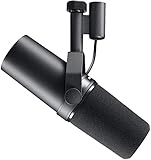
The Beyerdynamic M160 is another ribbon mic, but with a twist – it has a hyper-cardioid polar pattern. This is pretty unusual for a ribbon mic and makes the M160 a unique tool in your mic locker.
Like other ribbon mics, the M160 has that smooth, natural sound that can add a vintage vibe to your recordings. But thanks to its hyper-cardioid pattern, it’s better at rejecting off-axis sound than most ribbon mics. This means you can use it in situations where other ribbons might pick up too much room sound.
The M160 really shines on overdriven guitar tones. It has a way of capturing the aggression and bite of a distorted amp while smoothing out any harshness. It’s been used on countless classic rock recordings, and for good reason. However, it might not be the best choice for super clean tones – it can sometimes make them sound a bit dull.
Pros:
- Unique hyper-cardioid ribbon design
- Great for overdriven tones
- Adds vintage vibe to recordings
Cons:
- Not ideal for all guitar sounds
- More expensive than dynamic mics
Click To Read Reviews at Amazon.com -->
How to Choose the Right Microphone for Your Guitar Amp
Alright, now that we’ve gone through our top picks, you might be wondering, “Which one should I choose?” Well, my friend, that depends on a few factors. Let’s break it down:
1. Consider Your Genre
Different genres often call for different tones, and certain mics excel at capturing specific sounds:
- Rock, Metal, Punk: Dynamic mics like the Shure SM57 or Sennheiser MD421 II are great for handling high volumes and aggressive tones.
- Blues, Jazz, Country: Ribbon mics like the Royer R-121 or Beyerdynamic M160 capture warm, smooth tones beautifully.
- Ambient, Experimental: Condenser mics like the AKG C414 XLII pick up lots of detail and space around the amp.
2. Think About Your Amp
The type of amp you’re using can also influence your mic choice:
- Tube Amps: Ribbon and condenser mics often capture the warmth of tube overdrive nicely.
- Solid-State Amps: Dynamic mics can help smooth out the sometimes harsh treble of solid-state amps.
3. Consider Your Recording Environment
Where you’re recording can make a big difference:
- Home Studio: If you’re in a less-than-ideal acoustic space, a mic with a tighter polar pattern (like a super-cardioid) can help minimize room reflections.
- Professional Studio: In a well-treated room, you might want to experiment with mics that capture more ambience, like the figure-8 pattern of the Royer R-121.
4. Think About Your Budget
Let’s face it, budget is always a factor. Here’s a rough guide:
- Under $500: You can get great dynamic mics like the SM57 or E609 Silver in this range.
- $500-$1000: This is where you’ll find higher-end dynamic mics and some entry-level condensers and ribbons.
- Over $1000: This is the realm of premium condensers and ribbons like the C414 XLII and R-121.
Remember, more expensive doesn’t always mean better for your specific needs!
Mic Placement Tips for Guitar Amps
Now that you’ve chosen your mic, let’s talk about how to place it. Mic placement can have a huge impact on your tone, often even more than the choice of mic itself. Here are some tips:
- Start at the center of the speaker: This will give you the brightest, most direct sound.
- Move towards the edge: As you move towards the edge of the speaker, the tone will become warmer and less bright.
- Distance matters: Close-miking (1-3 inches from the grille) will give you a more focused, present sound. Moving the mic back will capture more room sound and can sometimes sound more natural.
- Off-axis placement: Pointing the mic slightly off-center can help tame harsh highs.
- Experiment with angles: Angling the mic can change the tone. A 45-degree angle often works well.
- Use multiple mics: Try combining two different mics for a more complex tone. The SM57 and R-121 are a classic combo!
Remember, there are no hard and fast rules here. Use your ears and experiment to find what sounds best for your particular setup.
FAQs About Guitar Amp Microphones
Before we wrap up, let’s address some common questions I often hear about miking guitar amps:
Q: Can I use a vocal mic on my guitar amp?
A: Absolutely! Many mics designed for vocals, like the Shure SM58, can work great on guitar amps. The SM58 is essentially an SM57 with a different grille. That said, mics designed specifically for instruments might give you better results, especially at high volumes.
Q: Do I need a different mic for acoustic and electric guitars?
A: While you can use the same mic for both, acoustic and electric guitars often benefit from different mic choices. For acoustics, large-diaphragm condensers like the AKG C414 XLII are popular for their ability to capture the full frequency range and subtle nuances of the instrument.
Q: How many mics should I use on my guitar amp?
A: There’s no one-size-fits-all answer here. A single well-placed mic can sound fantastic, but using multiple mics can give you more options when mixing. A common technique is to use two mics – maybe an SM57 close to the grille and a room mic further back to capture some ambience. Experiment and trust your ears!
Q: Can I use these mics for other instruments too?
A: Definitely! Many of these mics are incredibly versatile. The Sennheiser MD421 II, for instance, is great on drums, brass instruments, and even vocals. The AKG C414 XLII is a studio workhorse that sounds great on almost anything.
Q: Do I need a special preamp for ribbon mics?
A: While not absolutely necessary, a good preamp can really help you get the most out of a ribbon mic like the Royer R-121 or Beyerdynamic M160. Ribbon mics typically have a lower output than dynamics or condensers, so a clean preamp with lots of gain can be beneficial.
Final Thoughts: Your Guitar Tone Journey
As we come to the end of our deep dive into the world of guitar amp microphones, I hope you’re feeling inspired to experiment with your tone. Remember, the mics we’ve discussed here are tools – incredibly useful tools, but tools nonetheless. The magic happens when you combine the right mic with the right amp, the right guitar, and most importantly, your unique playing style.
Don’t be afraid to break the “rules” either. Some of the most iconic guitar tones in history came from happy accidents or unconventional techniques. Maybe you’ll discover that your SM57 sounds killer on your guitar, or that your Royer R-121 adds the perfect touch to your clean tones.
And hey, if you’re feeling overwhelmed by all the options, remember this: countless classic records have been made with nothing more than a Shure SM57 slapped in front of a guitar cab. Sometimes, simplicity is key.
So go forth and experiment! Try different mics, play with placement, adjust your amp settings, and most importantly, have fun with it. After all, that’s what making music is all about.
Keep rocking, and may your tones always be epic! 🎸🤘