As a music producer, finding the right microphone for recording rap vocals is crucial. The mic you choose can make or break the quality of the vocal recording, which is the most important element in hip hop and rap.
Best Mic for Rap Vocals: Our Top Picks
In this comprehensive guide, I’ll walk you through everything you need to know about choosing the best microphone for rap and hip-hop vocals.
| Microphone | Type | Polar Pattern | Frequency Response | Sensitivity | Impedance |
|---|---|---|---|---|---|
Shure SM7B | Dynamic | Cardioid | 50Hz – 20kHz | -59 dBV/Pa | 150 ohms |
Neumann TLM 102 | Condenser | Cardioid | 20Hz – 20kHz | 15 dBV/Pa | 50 ohms |
AKG C414 XLII | Condenser | Cardioid, Omni, Figure 8 | 20Hz – 20kHz | 13 dBV/Pa | 200 ohms |
Rode NT1-A | Condenser | Cardioid | 20Hz – 20kHz | -31 dBV/Pa | 100 ohms |
Sennheiser MD 421 | Dynamic | Cardioid | 30Hz – 17kHz | -53 dBV/Pa | 200 ohms |
Royer R-121 | Ribbon | Figure 8 | 30Hz – 15kHz | -56 dBV/Pa | 300 ohms |
Shure SM57 | Dynamic | Cardioid | 40Hz – 15kHz | -56 dBV/Pa | 350 ohms |
Why is the Right Microphone Important for Rap Vocals?
Rap and hip hop rely heavily on the vocal delivery and lyrical techniques of the MC. You need a microphone that accurately captures the subtle nuances, articulation, and emotion in the rapper’s voice.
The wrong mic can make the vocals sound muffled, harsh, or lifeless. It may boost the lows and cause muddiness or boost the highs and introduce sibilance (de-essing can fix this). Either way, the end result won’t be a transparent representation of the rapper’s true vocal tone.
Additionally, factors like the mic’s sensitivity and off-axis rejection affect how well it handles plosives without distortion and isolates the vocals from bleed. So choose wisely to get clean rap vocals that cut through the mix!
Types of Microphones for Rap Vocals
There are three main types of mics commonly used for recording hip hop and rap vocals:
Dynamic Microphones
Dynamic mics use electromagnetic induction to convert sound into electrical signals. They have a thin movable diaphragm attached to a coil of wire suspended in a magnetic field.
When the diaphragm vibrates from sound waves, the coil moves through the magnetic field and induces a voltage that gets sent to the output.
Pros:
- Rugged build quality
- Handle high SPL without distortion
- Less sensitive to ambient noise
- Affordable prices
Cons:
- Less detailed sound compared to condensers
- Need lots of gain for quiet sources
Popular dynamic mics: Shure SM7B, Sennheiser MD 421, Electro-Voice RE20
Condenser Microphones
Condenser mics use an electrically charged thin diaphragm stretched close to a metal backplate to capture sound. The diaphragm vibrates and causes fluctuations in capacitance that get converted into electrical signals.
Pros:
- Extremely detailed and transparent sound
- Wide, flat frequency response
- Excellent transient response
- High sensitivity
Cons:
- More prone to ambient noise
- Fragile – can be damaged by phantom power spikes
- Require external phantom power
Popular condensers: Neumann TLM 102, AKG C414, Rode NT1-A
Ribbon Microphones
Ribbon mics work based on a thin aluminum ribbon suspended between magnets that moves when hit by sound waves. The ribbon’s movement in the magnetic field generates the signal.
Pros:
- Smooth, natural tonal balance
- Great mid-range detail
- bidirectional polar pattern
Cons:
- Low sensitivity and output
- Fragile ribbon is sensitive to strong air gusts
- Needs proper impedance matching
Popular ribbons: Royer Labs R-121, AEA R84, Coles 4038
Features to Consider When Choosing a Microphone for Rap Vocals
Let’s go over the key specifications and characteristics to evaluate when shopping for the best rap vocal microphone:
Frequency Response
This indicates the mic’s range of accurately reproduced frequencies. For vocal mics, a full frequency spectrum of 20Hz – 20kHz is ideal to capture the entire range of the human voice from low bass to sibilance.
Mics with an extended high-frequency response above 20kHz can give vocals extra air and clarity. Look for mics rated down to at least 60hz on the low end which helps capturing a full-bodied vocal tone.
Polar Pattern
The polar pattern determines how sensitive the mic is to capturing sounds from different directions.
- Cardioid – most common, picks up sound mainly from the front while rejecting off-axis sound from sides/rear. Good isolation helps avoid bleed from nearby instruments.
- Bidirectional – equal sensitivity at front & rear, rejects sides. Useful for a two-person interview-style recording.
- Omnidirectional – equal sensitivity all around. Can introduce bleed but creates a “roomy” natural sound.
Sensitivity
This spec indicates how well the microphone converts acoustic energy into output voltage. Sensitivity is measured in decibels relative to 1 Volt per Pascal (dBV/Pa).
Higher sensitivity mics require less amplification and allow more distance from the sound source. But they also increase risk of distortion from extremely loud transients.
Lower sensitivity mics can handle high SPL without distorting but need more gain from the preamp. They work best close-mic’d.
Impedance
Impedance is measured in Ohms and affects how susceptible the mic is to interference from longer cable runs.
Low impedance mics (150 to 300 ohms) work well with long cables. Most modern pro mics have low impedance.
High impedance (10,000+ ohms) mics are more prone to interference but can sound sweeter on certain sources like vocals and acoustic guitars.
Self-Noise
This measures the equivalent SPL (in dB) of the mic’s inherent noise floor. Lower numbers mean less hiss and hum. Under 20 dB is excellent for studio vocal mics.
Dynamic mics tend to have lower self-noise while large condensers are more susceptible. Too high self-noise can force you to gate vocals to remove it.
Best Microphones for Rap Vocals in 2026
Now let’s get into my top picks for the best rap and hip hop vocal microphones across various budget ranges:
Dynamic Microphones
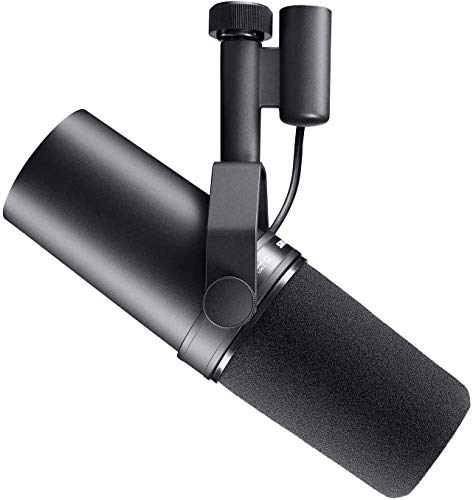
Shure SM7B
Check the price of the Shure SM7B at Amazon
The legendary Shure SM7B needs no introduction – it’s an absolute staple in pro studios for warm, smooth rap vocals.
Key features:
- Flat, neutral frequency response with a slight presence boost
- Bass roll-off and mid-range emphasis switches
- Excellent shielding against electromagnetic interference
- Internal shock mount to reduce vibrations
The SM7B has been used on classic hip-hop albums from artists like Notorious B.I.G to Eminem. It handles loud vocals with ease thanks to its dynamic design. The built-in pop filter minimizes plosives and breath pops.
Just be prepared to use a preamp with high gain as the SM7B’s low sensitivity requires additional amplification. But once properly set up, it delivers iconic smooth radio voice quality perfect for rap.
Reasons to Buy:
- Warm, smooth sound perfect for vocals
- Handles loud sources without distortion
- Effective built-in pop filter
- Mid-range presence boost switch
- Excellent ambient noise rejection
Reasons to Avoid:
- Requires high gain preamp due to low sensitivity
- Detailed but not as airy as condensers
- Only cardioid polar pattern option
Shure SM57

Check the price of the Shure SM57 at Amazon
The Shure SM57 is right up there with the SM7B as one of the most popular professional studio mics ever created.
Key features:
- Warm, balanced frequency response
- Extremely durable build quality
- High SPL handling – up to 140 dB
- Cardioid pickup pattern rejects off-axis sound
Don’t let its modest price tag fool you – the SM57 punches way above its weight. It’s not just an instrument mic, vocalists love its smooth mid-range presence bump that cuts through mixes.
The SM57 naturally accentuates fundamentals for an upfront intimate vocal sound. It also has some proximity effect to thicken up the low end. Set up properly, an SM57 can compete with mics costing 10X more!
Reasons to Buy:
- Proven dynamic with warm balanced tone
- Extremely durable build
- Handles very high SPL without distorting
- Affordable price & industry standard
Reasons to Avoid:
- Less detailed than condensers
- Prone to proximity effect bass boost
- Mainly an instrument mic, better vocal options
Sennheiser MD 421

Check the price of the Sennheiser MD 421 at Amazon
With its recognizable vintage design, the Sennheiser MD 421 is one of my favorite dynamic mics for hip hop vocals needing some beef and grit.
Key features:
- Boosted lows and highs with scooped midrange
- 5 position bass roll-off filter up to 300 Hz
- Exceptional off-axis rejection for isolation
- Rugged metal construction
The MD 421 adds distinctive character to vocals – a big low end paired with crisp articulate highs that cut through mixes. The mid-scoop helps vocals take center stage.
The 421 comes with a 5 position bass filter so you can dial in just the right low-end contour for a rapper’s voice. Thanks to the cardioid capsule, bleed from nearby sound sources is minimized.
When you need a dynamic mic with more personality for hip hop vocals, the Sennheiser MD 421 delivers definitive tone and authority.
Reasons to Buy:
- Distinctive mid-scooped frequency response
- Handles extremely high SPL without distorting
- Excellent ambient bleed rejection
- Vintage look and sound
Reasons to Avoid:
- Prone to proximity effect bass boost
- Needs a windscreen for breath pops
- May introduce colored tone on some sources
Condenser Microphones
Neumann TLM 102

Check the price of the Neumann TLM 102 at Amazon
The Neumann TLM 102 carries the prestigious Neumann pedigree at a price point accessible for most home studios.
Key features:
- Natural, open sound with silky highs
- 20Hz – 20kHz frequency response
- Cardioid polar pattern provides isolation
- 144 dB max SPL before clipping
Neumann is the gold standard when it comes to large-diaphragm condensers. The TLM 102 retains that immaculate transparency and accuracy that sounds flattering on all vocal styles.
From lush rich lows to smooth extended highs, the TLM 102 adds just the right polish and sheen to rap vocals without sounding over-hyped. It’s as close as you’ll get to that hit-making Neumann sound on a budget.
Reasons to Buy:
- Silky highs and natural open sound
- The Neumann pedigree at an affordable price
- Smooth off-axis response
- Versatile for all vocal styles
- Durable metal construction
Reasons to Avoid:
- Only cardioid pickup pattern
- Lacks multiple attenuation pad options
- No high pass filter switch
AKG Pro Audio C414 XLII

Check the price of the AKG Pro Audio C414 XLII at Amazon
The C414 XLII is AKG’s premier large-diaphragm FET studio condenser. It offers stunning detail and versatility.
Key features:
- Switchable polar patterns – cardioid, omni, figure 8
- Multiple attenuation pads (-6, -12, -18dB)
- Vintage sound with airy extended highs
- Robust die cast zinc construction
The C414 excels on all sound sources. Vocals shine through smooth and focused, retaining detail even on the most subtle nuances without hyping any frequencies.
Being able to toggle between polar patterns gives you creative options to change up the mic distance and placement. The C414 delivers radio-ready polished vocal tracks, ideal for hip hop and rap. It’s built to last decades even with heavy studio use.
Reasons to Buy:
- Switchable polar patterns
- Multiple attenuation pads
- Vintage AKG sound quality
- Robust die cast zinc construction
- Amazing vocals and instrument miking
Reasons to Avoid:
- High price tag
- Requires 48V phantom power
- Detailed but not as warm as tube mics
Rode NT1-A

<strong>Check the price of the Rode NT1-A at Amazon</strong>
The Rode NT1-A gives you acclaimed LDC sound quality that outperforms its modest price point.
Key features:
- Smooth, extended frequency response
- Self noise of just 5 dB for clean gain boosting
- Cardioid polar pattern rejects off-axis sound
- Includes shock mount and pop filter
Rode’s 1-inch gold-sputtered diaphragm transducer captures vocals faithfully. The sound has clarity and intimacy without edginess or sibilance.
Being able to add lots of preamp gain without hiss allows optimal level riding to accentuate a rapper’s cadence and inflections. For home studios needing pro-grade condenser quality on a budget, the NT1-A is an top choice.
Reasons to Buy:
- Complete bundle with shock mount and pop filter
- Bright, airy, detailed sound
- Very low self-noise of 5dB
- Extended 20Hz – 20kHz frequency range
- Handles high SPL sources
Reasons to Avoid:
- Sterile sound that may need EQ
- Fixed cardioid polar pattern
- Sounds best on brighter voices
Ribbon Microphones
Royer Labs R-121

Check the price of the Royer Labs R-121 at Amazon
The Royer R-121 lets you capture velvety smooth vocals devoid of harshness.
Key features:
- Warm, rich low-mid tone
- Effortless transparency and accuracy
- Bi-directional figure 8 polar pattern
- Durable ribbon design
Royer Labs make some of the best ribbon mics for studio vocals. The R-121 has a dark yet intimate timbre that flatters the nuances of hip hop and R&B styles.
Ribbon mics exhibit less proximity boost compared to dynamics and condensers. This lets you work up close to emphasis articulation without muddiness. The Royer R-121 adds vintage vibes to rap vocals.
Reasons to Buy:
- Silky smooth vintage ribbon sound
- Intimate midrange detail
- Excellent side rejection in figure 8 pattern
- Durable ribbon transducer design
- No need for high gain preamp
Reasons to Avoid:
- Not as versatile as large condensers
- Ribbon is fragile and sensitive
- Needs proper impedance matching
- Fixed bi-directional polar pattern
AEA R84

<strong>Check the price of the AEA R84 at Amazon</strong>
Manufactured by legendary ribbon mic experts AEA, the R84 captures amazingly smooth natural sound.
Key features:
- Effortless realism free of artifacts
- Low self noise and distortion
- Figure 8 polar pattern provides excellent side rejection
- Vintage styling with classic ribbon tone
The hand assembled R84 uses AEA’s proprietary ribbon transducer technology that seems to magically convey the room ambience. Vocals take on a lifelike presence with the energy of a live performance.
For rappers who want that authentic dynamic moving air sound, ribbon mics like the AEA R84 are perfect. Your voice will be reproduced with remarkable transparency and accuracy.
Reasons to Buy:
- Incredibly lifelike, transparent sound
- Smooth top end free of harshness
- Excellent ambient noise rejection
- Durable ribbon design able to handle SPL
- Intimate vintage ribbon microphone tone
Reasons to Avoid:
- Not as versatile as large condensers
- Ribbon is delicate and fragile
- Requires proper impedance matching
- Fixed bi-directional polar pattern
Coles 4038

Check the price of the Coles 4038 at Amazon
The Coles 4038 carries on the BBC design legacy in a compact ribbon mic form factor.
Key features:
- Smooth rich low end
- Natural roll-off above 10 kHz
- Handles high SPL without distortion
- Swivel mount for optimal placement
Coles mics defined the British radio sound. The 4038 embodies that refined warmth and intimacy. Vocals take on a polished sheen with enhanced low mids and mellow highs.
Despite its small size, the 4038 has solid off-axis noise rejection so you can closely mic vocals without bleed. For rap and hip hop artists seeking vintage British tone, the Coles 4038 delivers!
Reasons to Buy:
- Iconic BBC smooth rich sound
- Compact durable ribbon design
- Swivel mount for positioning flexibility
- Handles high SPL without distorting
- Intimate vintage British broadcast tone
Reasons to Avoid:
- Less detail than large condensers
- Ribbon is fragile and sensitive
- Primarily suited for vocals
- Fixed bi-directional polar pattern
Microphone Accessories
Choosing the right mic is only half the story – proper accessories are key to optimizing sound quality and isolation when recording rap vocals:
Pop Filters
Pop filters are essential for catching plosives on vocal tracks. Quick thumps of air from explosive B and P sounds can distort mics. Pop filters dissipate the blasts before reaching the capsule.
Make sure to position the external pop filter 4-6 inches from the mic grille. I recommend dual-layer mesh filters that provide enhanced absorption compared to foam screens.
Shock Mounts
Shock mounts suspend mics in a cradling system of elastic bands to isolate them from vibrations and noise. This helps eliminate rumble caused by footsteps or moving gear stands from ruining vocal takes.
Internal shock mounts built into the mic’s casing work great but external mounts give you more positioning flexibility. Make sure the mount clamps easily onto any mic stand.
Shock Mounts
Shock mounts suspend mics in a cradling system of elastic bands to isolate them from vibrations and noise. This helps eliminate rumble caused by footsteps or moving gear stands from ruining vocal takes.
Internal shock mounts built into the mic’s casing work great but external mounts give you more positioning flexibility. Make sure the mount clamps easily onto any mic stand.
Mic Stands
A sturdy weighted mic stand is critical for positioning your vocal mic optimally relative to the rapper’s mouth. This ensures maximum isolation and control.
Floor stands with a heavy circular cast iron base tend to be the most stable and resistant to tipping over. Boom arms allow angling the mic closer from above.
Use mic clips to securely attach mics to stands instead of directly screwing on to avoid damaging threads. Make sure clamps have dense padding or rubber grips to prevent scratching mic bodies.
Microphone Preamps
In addition to choosing the right microphone, using a quality preamp is key to achieving clear, noise-free rap vocals:
What is a Microphone Preamp?
The preamp (pre-amplifier) is the interface between the mic and your recording device like a computer interface or mixing desk. The mic signal is very weak when it comes out of the capsule and needs to be boosted.
Preamps take this low-level signal and amplify it to a strong, healthy line-level or XLR output that can be sent to your audio interface for recording and processing.
Why is a Microphone Preamp Important for Rap Vocals?
Preamps play a huge role in determining the final sound quality – they provide essential amplification along with sonic coloring and distortion characteristics.
The best preamps have ultra low-noise, allowing the mic signal to be boosted without introducing hiss or hum. High headroom handles transients without clipping.
Great preamps also have output transformers that add pleasing harmonic saturation. This lends warmth and dimensionality to vocals.
Best Microphone Preamps for Rap Vocals in 2023
Some of my favorite preamp options for getting studio-grade rap vocal recordings are:
Solid State Preamps
- ART Pro MPA II – clean, accurate tonal balance
- Focusrite ISA One – versatile vintage sound
- Presonus Quantum 2 – ultra-low noise floor
Tube Preamps
- Chandler Limited TG2 – British vintage tone
- Warm Audio WA12 – boutique all-tube preamp
- Universal Audio 6176 – classic vintage limiting & compression
Recording Rap Vocals in a Home Studio
Here are some tips for getting pro-level results when recording rap vocals at home:
Tips for Setting Up a Home Recording Studio
- Treat acoustic problems – use foam pads and bass traps to tame reflections and flutter echo that obscures detail
- Low noise floor – shut off all unnecessary electronics to keep noise down
- Pop filter – use one religiously to prevent plosives from distorting takes
- Closed-back headphones – prevent headphone bleed from leaking into the vocal mic
- Shock mount – suspend the mic properly to avoid vibrations
- Level match – test input sensitivity & gain staging to prevent clipping
Best Microphones for Recording Rap Vocals at Home
- Shure SM7B – dynamic design rejects ambient noise well
- AKG P420 – budget LDC with high 136dB SPL handling
- Rode NT1-A – condenser with shockmount & pop filter included
- Sennheiser MK4 – clear studio-quality cardioid dynamic mic
- sE Electronics X1 A – affordable condenser with detailed sound
Use dynamic mics if recording in an untreated room. Their ambient bleed rejection allows close miking vocals cleanly.
For treated spaces, large-diaphragm condensers capture intricacies and airiness beautifully if you need to work further from the mic.
How to Use a Microphone for Rap Vocals
Here are some tips on optimizing your mic setup when recording rap vocals:
Positioning the Microphone
- Place 4-8 inches away, pointed at the mouth
- Use taller stands for rappers to avoid being hunched over
- Angle just off the side of the mouth to reduce plosives
- Adjust distance & angle until the voice is clearly defined
Gain Staging
- Start with gain knob low and increase until sustained singing is just under peak levels
- Leave ample headroom for transients and loud sections
- Use compressor/limiter if needed to control dynamics
EQ and Compression
- Add subtle boost around 5kHz for vocal presence
- Slight boost above 10kHz can add air and clarity
- Compress vocals gently (2:1 or 3:1 ratio) to add density
- De-ess for reducing harsh sibilance and clicks
Tips for Recording Great Rap Vocals
Here are some final tips to remember when recording rap and hip hop vocals to get impactful tracks:
Warm Up Your Voice
Doing vocal warm-ups and conditioning prepares your voice so you can perform at your best in the booth. This improves stability, power, and helps you avoid voice strain.
Use a Pop Filter
Plosives can seem exaggerated on rap vocals. Using a quality pop filter prevents them from causing harsh distortion during energetic performances.
Record in a Quiet Environment
Tracking rap vocals requires hearing every subtle nuance clearly. Minimize external noise that might distract from the intimacy.
Experiment with Different Microphone Placements and Settings
Every rapper’s voice is unique! Take time to try various mic models, distances, and angles until you discover the perfect complementary sound.
Conclusion
Choosing the ideal microphone and optimizing its positioning is crucial to achieve clean, detailed rap vocals that shine through mixes. The key is finding a mic that conveys the genuine tonal qualities of the rapper’s voice.
My top mic recommendations for warm, smooth hip hop vocals are the Shure SM7B dynamic and Neumann TLM 102 large condenser. For more aggressive, gritty rap delivery, the Sennheiser MD 421 dynamic and AKG Pro Audio C414 XLII large condenser are fantastic choices.
Always use a pop filter and shock mount properly to prevent plosives and noise. And don’t forget to experiment with room placement – proximity effect and ambience can drastically alter sound.
With these tips, you have everything you need to know about selecting the best mic and setup for incredible rap vocals! Let me know if you have any other questions.