The pro monitor space has had a gap at the top. Studios want wireless control, smarter room correction, and the kind of accuracy that translates a mix across every playback system. KRK’s V Series Five has just arrived — and it delivers all of that and then some. Verdict up front: this is the most ambitious monitor KRK has ever built, and if you’re serious about how your mixes sound, it demands your attention.
What’s Actually in the Box
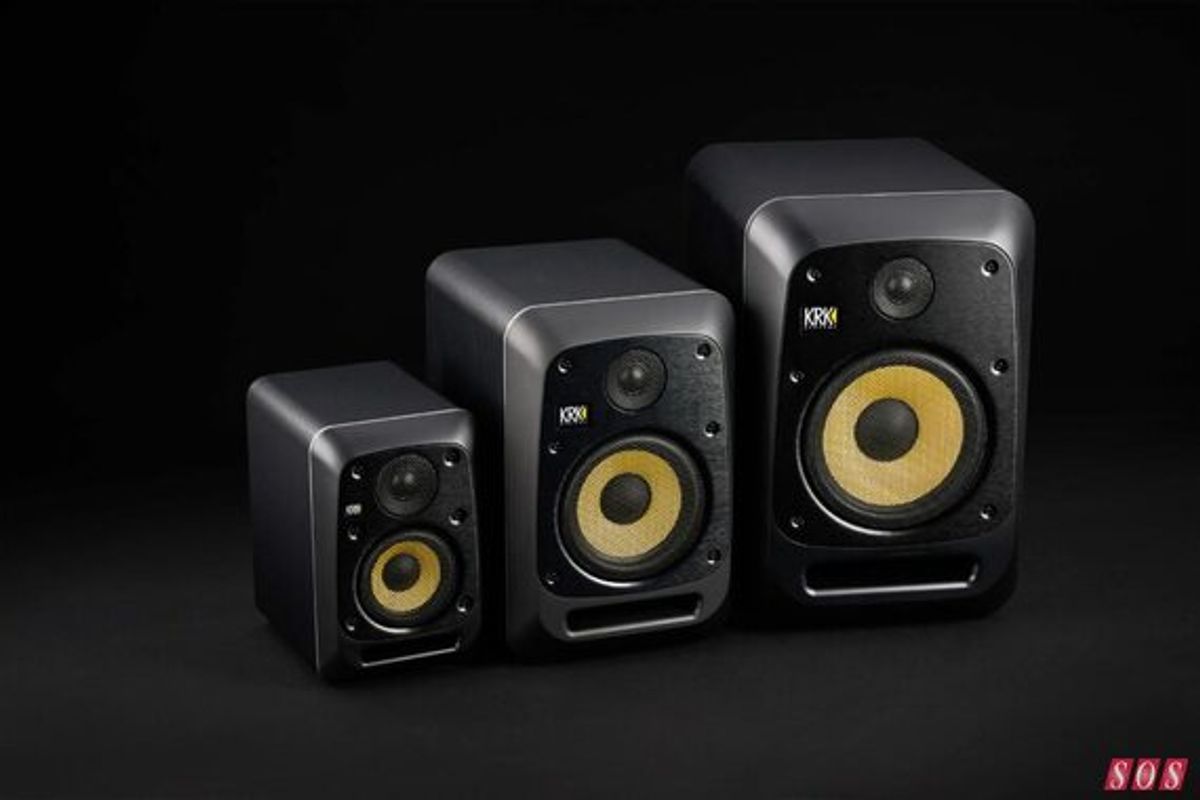
Three models. One shared platform. All built with the kind of components you’d normally pay a lot more for.
| Model | Woofer | Frequency Response | Peak SPL | Price |
|---|---|---|---|---|
| V4 | 4-inch Kevlar | 48 Hz – 40 kHz | 113 dB | $649 |
| V6 | 6.5-inch Kevlar | 40 Hz – 40 kHz | 118 dB | $849 |
| V8 | 8-inch Kevlar | 32 Hz – 40 kHz | 121 dB | $1,049 |
Every model runs ESS converters, Analog Devices DSP, and Pascal Class D amplification — 280 watts to the low driver, 175 to the tweeter. That’s 450 total watts of clean power in a nearfield monitor. The 1-inch silk dome tweeter pairs with an integrated waveguide to keep imaging locked in even when you move off-axis.
The Real Story: KRK Mesh Wireless Control
This is what makes the V Series Five genuinely different. KRK Mesh pairs the monitors with the KRK Control App on your phone. Adjust EQ settings, compare tuning profiles, set levels, and reconfigure your speaker layout — all without touching the unit on your desk.
Running a Dolby Atmos room with six or eight monitors? You can group them and control everything at once. That’s a real workflow upgrade. Previously, dialing in a multi-monitor Atmos rig meant crawling behind racks to reach rear monitors. Not anymore.
Room Tuning Tools
- 49 Boundary EQ presets
- 7 fully parametric PRO EQ filters
- 3 storable user presets
- Instant recall for A/B comparisons
Connectivity
- Neutrik XLR/TRS combo inputs
- AES3 digital input support
- Ground lift switch
- Adjustable input sensitivity
- Integrated mounting points
What the Press Release Doesn’t Tell You
KRK touts wireless control as the headline — but here’s what they’re quiet about. The app-based workflow means your monitor settings live on your phone. What happens if the app gets a bad update mid-session? What happens on tour or in a rental studio where you can’t guarantee connectivity?
The DSP-heavy platform also raises a question: how does it sound in bypass? Great converters and DSP can be spectacular, but engineers who want a pure analog path may find themselves navigating more menus than they’d like. KRK hasn’t published an analog bypass spec, and that matters.
These aren’t dealbreakers. They’re real-world considerations that reviews built from press releases skip over. If you’re building out your recording studio setup, they’re worth factoring into the decision.
How It Stacks Up Against the Competition
If you’re already running Genelec 8040s or Focal Alpha 65s, the V Series Five won’t make you throw out your rig. Those are excellent monitors in a similar tier.
But if you’re still working on a pair of aging first-gen KRK Rokits or entry-level budget monitors, this is the upgrade that changes how you hear your work. The jump from 85W to 450W of amplification alone is transformative. Add 49 room-correction presets and wireless control, and you’re operating at a completely different level. Check out our guide to the best budget studio monitors to see exactly where this fits in the wider market.
Who Should Actually Buy This?
✅ Buy This If…
- You’re a serious home studio producer ready to move past entry-level monitoring
- You produce Dolby Atmos or immersive audio and need grouped wireless control
- Your room changes (you work in multiple studios or a hybrid setup)
- You value deep room correction tools without a separate plugin subscription
- You want reference-grade studio monitors that grow with your career
❌ Skip This If…
- You’re a beginner just learning to mix — start with quality studio headphones and a budget monitor first
- You already own top-tier reference monitors in the same price bracket
- Your room is completely untreated — acoustic treatment should come before a $1,000 monitor upgrade
- You’re a content creator who just needs decent sound for voiceovers and podcast editing
The Bottom Line
The KRK V Series Five isn’t chasing a trend. It’s solving real problems that working engineers actually have — room adaptation, workflow speed, and multi-monitor control. The Kevlar drivers and Pascal Class D platform deliver the accuracy the V Series has always been known for, and the addition of KRK Mesh wireless control makes this a genuinely modern tool. At $649 for the V4, it’s accessible. At $1,049 for the V8, it’s competitive with monitors that offer far less flexibility. If you’re ready to take your studio monitoring seriously, this is where the conversation starts.
🔗 Check out the KRK V Series Five on the official KRK website: krkmusic.com — V Series Five
Does the KRK V Series Five look like a winner to you, or is the price tag too steep for what you’re getting? Drop your thoughts in the comments below — we want to hear where you land.