The soft synth market loves a classic — and nothing has been more hotly emulated in 2026 than the Moog Memorymoog. Arturia took a swing at it. Cherry Audio followed. Now XILS Lab MemoryTone has entered the ring, and here’s the honest verdict upfront: this is the most authentically engineered take of the three, built by a developer with a serious track record. But “most authentic” doesn’t always mean “most practical.” Let’s dig in.
The Specs — No Fluff
Here’s what MemoryTone actually delivers, stripped of marketing language:
| Feature | What You Get |
|---|---|
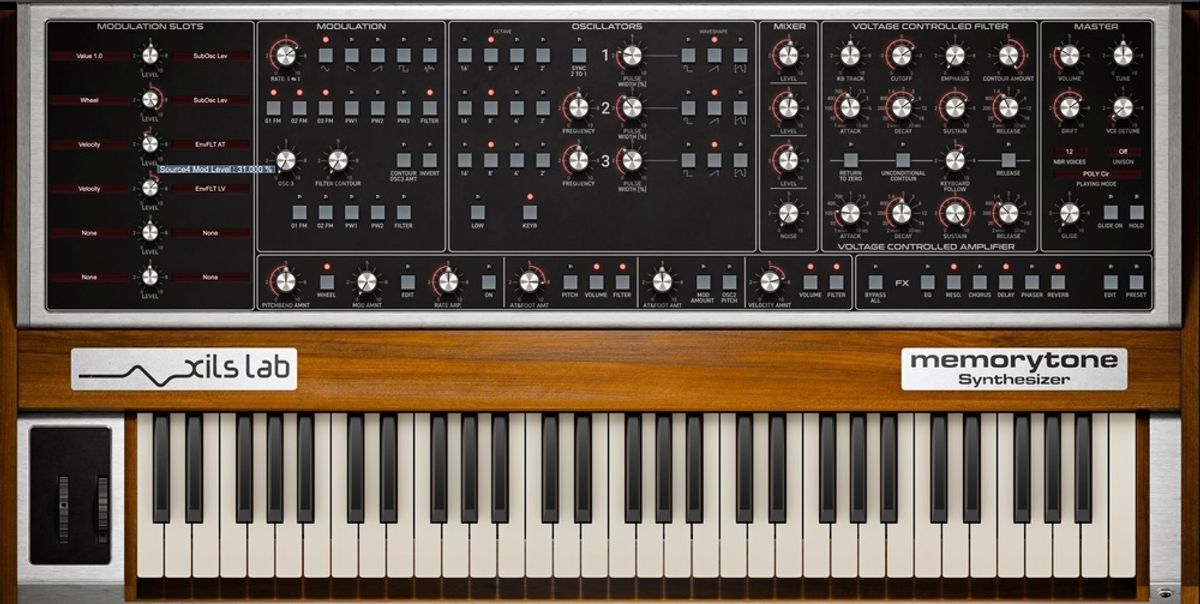
| Oscillators | 3 per voice — pulse, sawtooth & triangle, freely combinable; up to 18 across 16 voices |
| Sub-Oscillator | Doubles as a third LFO — flexible modulation trick the Memorymoog never had |
| Filter | 24dB self-oscillating ladder filter with emphasis, contour, and key tracking |
| Mixer | 4-channel with level-dependent drive and saturation built in |
| Envelopes | 2 ADSR generators with keyboard follower and switchable return-to-zero |
| Modulation | 6-slot assignable matrix; LFO + Oscillator 3 + sub-osc as three modulation sources |
| Expression | Full MPE, aftertouch, velocity, pitch bend — polyphonic voice modulation |
| Effects | Chorus, Delay, Phaser, Reverb, EQ, Resonator — independently routable |
| Arpeggiator | Mono & polyphonic modes, swing, gate, octave extension, random patterns |
| Formats | VST, VST3, AU, AAX — macOS (Apple Silicon native) + Windows |
| Protection | iLok software or hardware dongle required |
| Price | $79 intro (until Nov 1, 2026), then $199 regular |
What They’re Not Telling You
The product page talks about “magic.” That’s fair — this thing can genuinely sound massive. But three things didn’t make the headline, and you deserve to know them before you buy.
iLok Is Back — and Not Everyone Is Happy
In 2026, most plugin developers have quietly moved on from iLok. XILS Lab hasn’t. You’ll need the iLok app installed (or a physical dongle on your desk) just to run MemoryTone. For some, that’s a minor inconvenience. For others — especially producers with locked-down studio machines — it’s a dealbreaker worth knowing about before checkout.
Early users on Windows running the VST3 version in Cubase reported that the preset arrow navigation wasn’t working properly — you had to click each preset individually instead of scrolling through them. It’s a workflow irritation more than a sound issue, but for a plugin at this price point, polish matters. Keep an eye on XILS Lab’s update page.
A Crowded Race
This is the third Memorymoog emulation to land in 2026 alone. Arturia’s Memory V arrived in May. Cherry Audio updated Memorymode to version 2 in August. MemoryTone is arriving last — which means the burden of proof is on it to justify the ask. At $79 intro, the math works. At $199 regular? That’s a harder conversation.
“The filter responds to everything that came before it. Oscillators interact. Levels influence behaviour. Voices move.”
— XILS Lab on MemoryTone’s signal path
How Does It Stack Up?
If you already own Arturia Memory V, MemoryTone won’t flip your workflow. Arturia gives you layers, modern effects, and the full V Collection integration. It’s the more feature-rich choice from a bigger brand.
If you’re coming from Cherry Audio Memorymode 2 — which is significantly cheaper and beginner-friendlier — MemoryTone offers deeper authenticity, a more sophisticated modulation matrix, and proper MPE support for expressive playing. It’s the upgrade for players who want more than presets. Pair it with one of our recommended MIDI keyboard controllers that support MPE and you’ll unlock everything MemoryTone is built to do.
XILS Lab’s reputation speaks for itself here. Their CS-80 emulation “The Eighty” is widely considered one of the finest vintage recreations in the plugin world. MemoryTone comes from the same meticulous hand. The sound design depth is real.
Who Should Actually Buy This?
✅ Buy This If…
- You’re a Moog purist who wants the authentic 1982 Memorymoog architecture
- You have an MPE-capable controller and want expressive polyphonic performance
- You loved XILS Lab’s “The Eighty” CS-80 emulation and trust the developer
- You want fat, evolving pads, thick leads, or vintage polysynth bass
- You’re building a home studio and want one serious analogue-flavored workhorse
- You’re buying during the intro window — $79 is a fair price for this quality
❌ Skip This If…
- You already own Arturia Memory V — MemoryTone won’t add enough new ground
- iLok software is a hard no in your studio workflow
- You’re on a tight budget — Cherry Audio Memorymode 2 is the smarter entry point
- You primarily produce hip-hop, EDM, or pop and don’t need vintage poly textures
- You’re a Windows Cubase user who needs a stable VST3 experience right now
- You’re considering other new 2026 soft synths — there are strong alternatives this year
At $79 through November 1, 2026, XILS Lab MemoryTone punches well above its launch price. The filter is alive. The modulation matrix gives you genuine creative room. The MPE support sets it apart from every Memorymoog emulation that came before it. Does the iLok requirement and a few early bugs take the shine off? A little. But XILS Lab has a history of supporting their plugins well post-launch. The real question worth asking is this: in a year that gave us three Memorymoog emulations, does MemoryTone bring enough to the table to justify its spot on your hard drive — or does the intro price just make it easier to say yes without thinking twice? Tell us in the comments below.