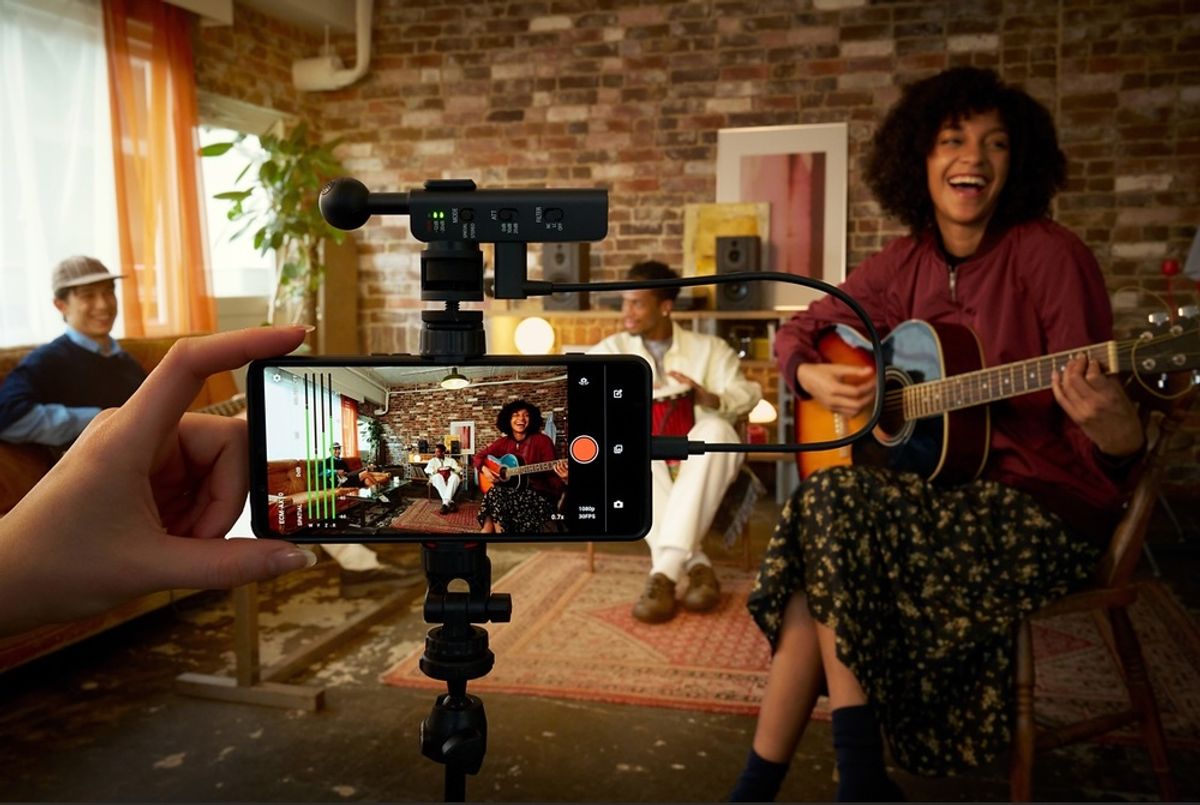
Smartphone audio has always been the weak link. You buy a great phone, shoot stunning video, and the sound is… flat. Lifeless. Nothing close to the immersive experience your footage deserves. Sony just changed the game. The Sony ECM-AX10 has arrived — and it’s the world’s first microphone certified for Eclipsa Audio spatial recording. Our verdict? This is one of the most genuinely exciting mobile audio accessories in years. But it’s not for everyone.
What Is the Sony ECM-AX10?

The ECM-AX10 is a compact USB-C microphone that plugs directly into your smartphone. Inside a newly developed spherical module sit four omnidirectional condenser capsules that capture sound from every direction around you simultaneously.
It weighs just 24 grams. No battery pack. No wireless dongle. No separate recorder. Just plug it in and go.
Specs at a Glance
| Capsules | 4× omnidirectional back electret condenser, spherical module |
| Recording Modes | Ambisonics (spatial), Binaural, Stereo |
| Resolution | 48 kHz / 16-bit, 24-bit integer, 32-bit float |
| Frequency Response | 20 Hz – 20 kHz |
| Max SPL | 120 dB or higher |
| Connection | USB-C (direct, bus-powered) |
| Monitoring | 3.5mm headphone output (zero latency) |
| Motion Sensor | 6-axis (3-axis gyroscope + 3-axis accelerometer) |
| Weight | ~24g / ~116mm |
| Compatibility | iOS 18+ / Android 14+ with USB-C |
| Price | $249.99 USD / $349.95 AUD / ~¥30,000 |
| In the Box | Windscreen, 40cm USB-C extension cable, hot-shoe mount |
The Three Recording Modes — What They Actually Mean
This is where the ECM-AX10 gets interesting. Most smartphone mics give you one mode. This one gives you three, and they serve very different purposes.
- Ambisonics (Spatial): Full 360-degree sound capture encoded for immersive playback — think YouTube’s Eclipsa Audio format, Sony 360 Reality Audio, and VR content.
- Binaural: Designed for headphone listeners. This mode creates a realistic 3D soundscape that places the listener right inside the scene.
- Stereo: Your everyday left-right capture. This works with any standard camera app, no special format needed.
Note: the noise-cut and low-cut filters are disabled in Ambisonics mode. Sony hasn’t explained this in detail — likely a technical trade-off to preserve the 360-degree signal integrity, but it’s worth knowing before you film somewhere loud.
What Sony Isn’t Telling You
The press release is polished, but a few real-world questions remain unanswered.
4K video support isn’t ready yet. Sony has confirmed 4K recording via the companion app is “planned from December.” That’s a notable omission for a product launching now, especially at $249.
The companion app is required for full functionality. Without the Spatial Audio Video Tool app, you lose the spatial editing, the orientation controls, and the export pipeline. It currently supports iOS 18+ and Android 14+. Older devices are out of luck entirely.
No dialogue optimisation. Sony itself acknowledges the ECM-AX10 is not a replacement for a dedicated dialogue mic. Point it at a single speaker in a room and you’ll capture everything behind them too — traffic, air conditioning, the lot. That’s the physics of omnidirectional capsules. For focused vocal recording, check out our guide to the best USB microphones as a better fit.
How Does It Compare to the Competition?
If you’re already using a Shure MV88+ or a Rode Wireless GO II paired with your phone, the ECM-AX10 won’t replace your setup for interviews or voiceover work. Those tools are built to capture a single sound source cleanly.
But if you’re still relying on your phone’s built-in microphone for travel vlogs, live events, or immersive content — this is the upgrade you’ve been waiting for. Nothing at this price point puts certified Eclipsa Audio spatial recording in your pocket. That’s genuinely new territory. For a deeper look at the broader mic market, our best multi-pattern microphones guide puts the ECM-AX10’s approach in wider context.
Who Should Actually Buy This?
✅ Buy This If…
- You create travel, event, or lifestyle content and want immersive sound
- You’re building a spatial audio or 360-video workflow on your phone
- You shoot for YouTube and want Eclipsa Audio-compatible uploads
- You currently rely on your phone’s built-in mic — any upgrade will be dramatic
- Portability is non-negotiable
❌ Skip This If…
- You primarily record interviews, podcasts, or single-source vocals
- You need directional (cardioid/supercardioid) pickup rejection
- Your phone is older than iOS 18 or Android 14
- You want 4K spatial video right now — that’s not ready until December
- You’re a home studio producer — check our best condenser mics guide instead
Smart Features Worth Calling Out
The built-in accelerometer automatically detects which way the mic is oriented and adjusts accordingly. No more accidentally recording with the wrong side facing the subject. There’s also a dedicated SELFIE switch that flips the audio orientation for front-facing shooting — a genuinely thoughtful touch for vloggers.
The ATT (attenuator) switch gives you 0 dB, 10 dB, or 20 dB of gain reduction for loud environments. Combined with the auto gain control and peak indicators, you have real-time control over your levels — something most plug-in phone mics completely ignore. If you’re also thinking about your full recording chain, our recording studio equipment checklist is a useful companion read.
The Bottom Line
The Sony ECM-AX10 earns its headline claim. First Eclipsa Audio-certified smartphone mic, spatial recording in your pocket, genuinely useful smart features, and a form factor that disappears into your bag. The missing 4K support and the companion app dependency are real limitations — but they’re the kind of issues a firmware update or app patch can solve. At $249, this is a bold but fair price for technology that simply doesn’t exist anywhere else. If spatial audio is part of your content future, the ECM-AX10 is the clearest on-ramp available right now.
👉 View the Sony ECM-AX10 on Sony’s Official Product Page
Does the Sony ECM-AX10 look like a winner to you, or is $249 too steep for a spatial audio upgrade you can’t fully use until December? Drop your take in the comments below — we read every single one.