The best reverb pedals for guitar are all about creating the perfect sound. Whether you’re looking to recreate the sound of a concert hall or just want a little bit of echo, these pedals will do it for you. You’ll find that some offer more options than others depending on your needs and what sound you’re seeking.
To help you make an informed decision, we have scoured the market and identified the leading reverb pedals brands. Our selected products are a mix of price, brand and type. To make sure we’ve something for everyone—for beginners, pros, for acoustic guitar or a budget friendly one that will cost you around $100—we have something for you.
We also have a comprehensive buying guide detailing the factors you should consider when buying one.
What to Look for in a Great Reverb Pedal
Reverb is one of the most essential effects in any guitarist’s toolkit. It adds depth, space, and character to your tone—transforming a flat sound into something alive and three-dimensional. A good reverb pedal can make you sound like you’re playing in a cathedral, a small room, or even a lush ambient soundscape.
When selecting the best reverb pedal, we considered several key factors: sound quality, versatility, ease of use, build quality, and value for money. Whether you’re a gigging musician, a bedroom player, or a studio enthusiast, the right reverb pedal can elevate your tone and inspire your playing.
Best Reverb Pedals for Guitar: Our Expert Recommendations
Here are our top picks:
1. TC Electronic Hall Of Fame 2
All-Time Best Reverb Pedal Under $100
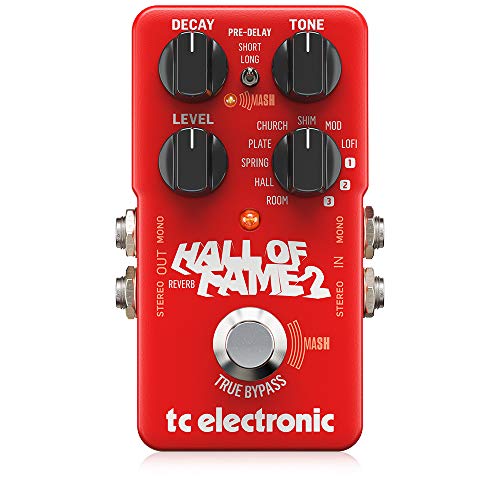
It’s very likely that you’ve heard of this one. It’s currently the Lamborghini in the world of reverb pedals. Hall of Fame 2 is a professionally designed stompbox that is creating a good buzz around due to its gold-standard performance and extreme versatility.
One feature that makes it stand out is its TonePrint feature. This is a million-dollar feature that lets you download additional sounds from the internet into your pedal or computer. This means that you are not limited to the sounds available in the pedal alone. You can access custom reverb settings created by professional guitarists and load them directly to your pedal via your smartphone.
Besides TonePrint, the TC Electronic Hall of Fame 2 reverb pedal offers you 10 different reverb types—including Church, Spring, Plate, Room, Hall, and even a lush Shimmer mode. That said, thou shall never get bored with the same sounds again. This pedal has also been designed to last, with a sturdy metal chassis and high-quality switches. It’s amazingly easy to use too. In fact, you won’t need the manual for that.
The Hall of Fame 2 also features MASH technology, which adds pressure-sensitive expression control to the footswitch. This means you can morph between settings or create dynamic swells just by pressing harder on the switch. It’s like having an expression pedal built right in.
Pros
- Stable and reliable
- Professional design with detailed, studio-quality sounds
- Download additional sounds online via TonePrint
- MASH technology for expressive control
- Superb versatility with 10 reverb modes
Cons
- Slightly pricey for beginners
Rating: ⭐⭐⭐⭐⭐ (5/5)
Best For: Intermediate to advanced players looking for maximum versatility and studio-quality reverb under $150.
2. Electro-Harmonix Holy Grail Nano
Best Spring Reverb Pedal

What are you looking for, the best spring reverb pedal on the market today? Electro-Harmonix Holy Grail Nano is certainly what you have in mind. Holy Grail Nano delivers unmatchable spring reverbs meticulously crafted for the hard-to-please guitarists. You’ll be blown away by what this little metallic box can do.
Spring isn’t the only reverb effect you get though. It also has beautifully detailed Hall and Flerb (a flanged reverb that adds a dreamy, chorus-like texture to your sound). This reverb pedal also has the most sought after wet/dry control knob. It lets you choose the amount of subtle reverb to be added to your outputs—from bone-dry to completely drenched in ambience.
The Holy Grail Nano is renowned for its simplicity. Just plug it in, select your reverb type, and dial in your mix. No complicated menus or digital displays—just pure, analog-voiced reverb goodness. The spring reverb mode, in particular, is revered for its authenticity. It captures that classic “drip” you’d expect from a vintage Fender amp.
Without forgetting, Holy Grail Nano also comes with a dedicated 96DC-200BI power supply. As such, you can take the unit for a drive immediately after arrival.
Pros
- Excellent spring reverbs with authentic vintage character
- Small size fits in most pedalboards
- Ships with a power supply
- Simple, intuitive controls
- True bypass switching
Cons
- Longer sound tail that’s not adjustable
- Only three reverb modes
Rating: ⭐⭐⭐⭐½ (4.5/5)
Best For: Players who want classic spring reverb tones without breaking the bank. Perfect for blues, surf, and classic rock styles.
Electro-Harmonix Holy Grail Nano
3. MXR M300 Reverb Guitar Effects Pedal
Best Premium Reverb Pedal for Studio Quality

MXR M300 is purposely for guitarists who want to keep their pedalboards simple but without compromising the amount of ambiance they get from the effects. At close to 200 bucks, the M300 is several folds pricier than most reverb pedals here. However, if you can purchase it, you’ll be glad you splurged on it thanks to its great sounds and whisper-quiet performance.
To begin with, MXR M300 has a simple 3-knob setup for easy navigation—Decay, Tone, and Mix. It has a visible blue LED that lights up to show when the pedal is active. Again, it offers 6 high-end reverb styles (Plate, Spring, Epic, Pad, Mod, and Room) each accompanied by a dedicated LED to show the selected reverb effect.
Just like you’d expect from a high-end reverb model, each of M300’s effects is detailed, pristine, and clean. You can choose to go either 100% dry or engage the 100% wet mode. It also has true relay bypass and trails mode, so your reverb tails naturally decay even after you turn the pedal off. This is crucial for live performance and studio work, where you want smooth transitions between sounds.
The MXR M300 supports both mono and stereo operation, making it a versatile choice for studio recordings or dual-amp rigs. The stereo imaging is particularly impressive, creating a wide, immersive soundscape.
Pros
- Straightforward setup with intuitive controls
- LED lights to show selected modes
- Supports mono and stereo functions
- Clean, detailed, and studio-quality sounds
- Trails mode for smooth transitions
Cons
- Switching between mono and stereo requires internal dip switches (not user-friendly)
- Higher price point
Rating: ⭐⭐⭐⭐⭐ (5/5)
Best For: Professional players and studio enthusiasts who demand pristine reverb quality and versatile stereo options.
4. Boss RV-6 Reverb Guitar Pedal
Best Overall Reverb Pedal for Versatility

In most instances, you’ll have to try out several units before getting the best for your guitar and other uses. But this mostly happens with 20-dollar units that can be easily replaced without a second thought. If you don’t want to go through this hectic process though, a professional unit like Boss RV-6 is all that you need. You’ll certainly get attached to this pedal from the word go.
It’s a small but effective box that delivers superb sounds from your electric guitar. Amazingly, there are only a handful of controls to tweak before you get the complete reverberations you’ve always wanted. Boss RV-6 packs 8 sound modes each with a unique algorithm—Room, Hall, Plate, Spring, Modulate, Shimmer, Dynamic, and Delay+Reverb. You can choose from a pool of old-school vintage effects to crisp modern-day textures.
The Shimmer mode is particularly popular among ambient and post-rock players. It adds an octave-up effect to the reverb tail, creating ethereal, choir-like textures. The Delay+Reverb mode is also handy, combining both effects in a single pedal to save valuable pedalboard space.
Not only this, but Boss RV-6 reverb pedal also supports both mono and stereo operations. It’s built like a tank, as you’d expect from Boss, and features their trademark rugged construction. This is a pedal that will last you for decades.
Pros
- Professional design and build quality
- 8 different sounds including Shimmer and Delay+Reverb
- Extremely durable
- Trails function available
- Stereo input/output
Cons
- No dedicated tone or pre-delay control
Rating: ⭐⭐⭐⭐⭐ (5/5)
Best For: All-around versatility. Ideal for players who want a reliable, feature-packed reverb pedal from a trusted brand.
5. Electro-Harmonix Holy Grail Neo
Best Mid-Range Reverb Pedal

Electro-Harmonix has been designing some of the most recommended reverb pedals for several decades now. Their Holy Grail series of guitar effects pedals is respected for its top-notch professional units. Neo Digital Reverb pedal is their latest addition, and it’s already headed for the top.
Unlike some budget options, Electro-Harmonix Neo offers you only 3 reverberation modes—Hall, Spring, and Plate. As few as they may be, this is the unit you want to turn to if you want real, authentic reverbs in your tones. The 3 algorithms are professionally tailored for electric guitars. However, you can also use it to color other instruments and voices too.
It also has a reverb knob that lets you switch from pure dry to 100% wet tones or anything else in between. The Neo’s strength lies in its simplicity and sonic quality. Each mode sounds rich, natural, and musical—no digital harshness or unnatural artifacts. The spring mode, in particular, rivals far more expensive boutique pedals.
The Holy Grail Neo also features true bypass switching, ensuring your signal remains pure when the effect is disengaged. It’s compact, durable, and sounds absolutely gorgeous.
Pros
- Reverb knob for dry and wet tones
- Truly impressive reverb sounds
- Professionally tailored for electric guitars
- True bypass mode
- Compact and pedalboard-friendly
Cons
- Only 3 reverb modes
- Mid-tier pricing
Rating: ⭐⭐⭐⭐½ (4.5/5)
Best For: Players who want high-quality, authentic reverb tones without the complexity of dozens of modes.
Electro-Harmonix Holy Grail Neo
6. Behringer DR600 Digital Stereo Reverb Effects Pedal
Best Entry-Level Option
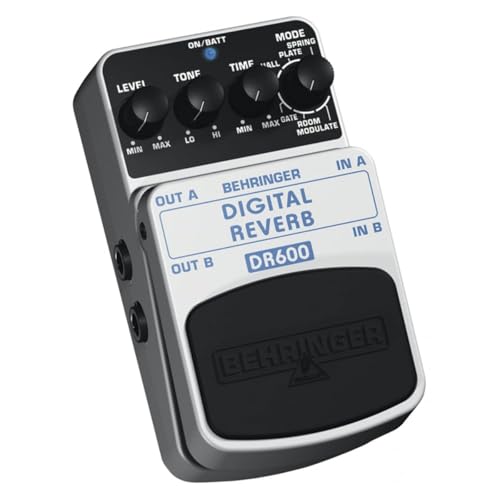
It’s fair to call Behringer’s DR600 a great deal reverb pedal for serious musicians on a budget. This reverb machine packs tons of cheesy features that you won’t find on any other reverb pedal in this price range. Sure, it might not beat the pricey Boss RV-6 and Holy Grail Neo in terms of pure sound quality. However, it’s of decent quality and offers greater flexibility with different types of styles.
Behringer DR600 tends to have a rather too busy face. But that’s because of its tons of modes—ranging from classic spring reverbs to some of the best-in-class modern tones. It also uses Behringer’s Real Sound Modeling Technology that employs DSP technology and some sophisticated algorithms to create some real acoustic environments.
Among other things, Behringer DR600 boasts a battery compartment with a dedicated battery check LED. It also has dedicated controls for Decay, Mix, Type, Time, Trails, and Tone—all of which you can tweak to get the shape of sound you want. For beginners experimenting with reverb, this is an affordable way to explore different sounds without spending hundreds of dollars.
Pros
- Runs on battery too (9V)
- Has tons of sounds and modes
- Real Sound Modeling Technology
- Very affordable
Cons
- Not ideal for professionals
- Build quality not as robust as higher-end models
Rating: ⭐⭐⭐½ (3.5/5)
Best For: Beginners or budget-conscious players who want to experiment with a wide range of reverb styles.
7. Donner Reverb Guitar Pedal
Great Option Under $50

Another unit that wouldn’t miss a slot is this unit by Donner. One thing that attracted us to this pedal is its compact design and the versatility it tucks therein. At 3.9″ x 2.4″ x 2.4″, Donner will easily fit on any pedalboard and also allow you to stack other pedals such as delay.
Another reason why we recommend this pedal is that it has intuitive controls, well labeled, and easy even for the starters to use. Donner has 7 reverberation modes that you can choose to color your mixes with—Room, Hall, Church, Plate, Spring, Studio, and Mod. All the modes sound great for the price point. You’ll certainly get several to fit your style. It also has a LED that lights up to show when it’s working.
Donner pedals have become increasingly popular among bedroom players and gigging musicians on a budget. While they may not compete with boutique brands, they offer surprising value and reliability. The true bypass switching ensures your tone stays intact when the pedal is off.
Pros
- Novel, compact design
- Extreme versatility at a low price
- 7 selectable modes
- True bypass available
- LED status indicator
Cons
- Some modes can sound a bit digital or less refined
Rating: ⭐⭐⭐⭐ (4/5)
Best For: Budget-conscious players who want versatility and compact size without sacrificing too much sound quality.
8. Deadbeat Sound THE VOID Reverb Effect Pedal
High-End Boutique Option

Are you looking for a reverb pedal that lets you rock without much tweaking? Enter the Void. This tank is for those who don’t want to spend much time hitting switches and control buttons. It’s quite unbeatable for its price and killer performances.
The Void has a small and compact design. It ships in a strong foam-padded storage box that keeps the pedal safe when on transit. The pedal itself is easy to use with only 2 control buttons—Mix and Decay. Cranking these 2 up gives you some nice warm analog-style tone that sits perfectly in your mixes. It also has the most revered True Bypass switch that lets you get natural, uncolored tones when need be.
What makes The Void special is its simplicity paired with its lush, ambient sound. It’s designed for players who want a “set it and forget it” reverb that just sounds good without endless tweaking. The analog-voiced digital reverb is smooth, warm, and never harsh—perfect for ambient, shoegaze, or post-rock styles.
Pros
- Easy controls—just Mix and Decay
- Nice warm analog-style tones
- Great storage box included
- True bypass switching
- Great pricing for boutique quality
Cons
- Lows and highs lack extreme definition
- Only one reverb type
Rating: ⭐⭐⭐⭐ (4/5)
Best For: Players who want a simple, ambient reverb pedal with boutique sound quality and minimal controls.
9. Rowin Ocean Verb Pedal Mini Guitar Effect
Budget Friendly Option

When purchasing a reverb pedal, there are 3 things that you’ll certainly consider: convenience, functionality, and durability. Fortunately, Rowin packs these and other great perks in their Ocean digital reverb pedal.
To start with, this reverb is hands down one of the cutest we came across. It has a presentable aluminum-alloy chassis and nicely aligned controls. It offers Room, Shimmer, and Spring reverb modes which can be altered via a toggle switch positioned between the Tone and Mix knobs.
Better enough, you can choose to go all-natural by zeroing all the effects by hitting the True Bypass switch. The Rowin Ocean Verb is part of the mini-pedal revolution, offering surprisingly good sound quality in a tiny footprint. The shimmer mode is particularly impressive for the price, adding ethereal octave textures to your reverb.
Pros
- LED status light
- Easy to use
- From a reputable brand
- True bypass switching
- Ultra-compact design
Cons
- Only 3 effects for the price
- Limited tone-shaping options
Rating: ⭐⭐⭐½ (3.5/5)
Best For: Players with limited pedalboard space who want a decent-sounding reverb pedal on a tight budget.
10. EX Mini Digital Reverb Pedal
Great for Beginners
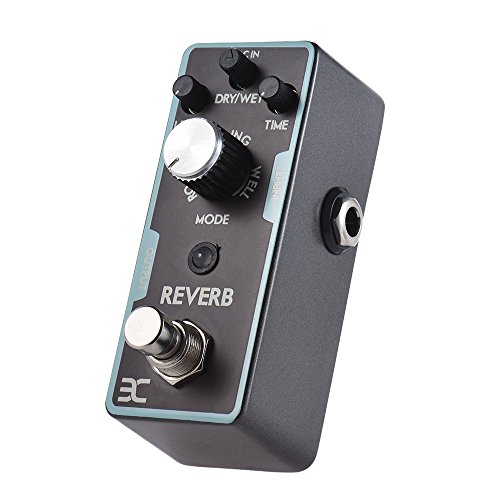
If you’ve just bought your guitar and want to experience some really good sound without spending much, this one is yours. For those strapped for cash, you’ll be amazed to find out EX costs way below 30 dollars. It’s also shipped to you free of charge (well, as at now!) thereby making it more affordable.
Despite being amongst the cheap reverb pedals on the market today, EX combines versatility and convenience to bring a stompbox you’ll never play your guitar without. It offers you a variety of sound effects modes including Echo, Space, Plate, Spring, Room, and Hall. It also has 4 functional knobs that let you alter the volume, reverberation time, and also switch from one mode to the other. Even better, you get a pedal that offers either dry or wet tones at the kick of a knob.
This is the perfect “first reverb pedal” for any guitarist. It’s inexpensive, easy to use, and offers a surprising amount of versatility. While it won’t compete with high-end models, it’s a great way to learn how reverb works and how to integrate it into your playing style.
Pros
- True bypass filter
- On/Off switch available
- Over 6 reverb modes
- Extremely affordable
- Great for learning and experimentation
Cons
- Build quality is basic
- Sound quality not as refined as pricier options
Rating: ⭐⭐⭐ (3/5)
Best For: Absolute beginners or players on an extremely tight budget who want to explore reverb effects.
Best Reverb Pedals by Category
Not all reverb pedals are created equal. Depending on your playing style, musical genre, and budget, you might need a specific type of reverb. Here’s a breakdown of the best reverb pedals by category to help you find the perfect match:
Best Budget Reverb Pedals
If you’re on a tight budget, you don’t have to sacrifice quality. The Donner Reverb Guitar Pedal and the EX Mini Digital Reverb Pedal are both excellent choices under $50. They offer a surprising amount of versatility and sound quality for the price. For a bit more investment, the Behringer DR600 packs tons of features and modes at an entry-level price.
Best Spring Reverb Pedals
Spring reverb is a classic effect that’s been used in guitar amps since the 1960s. It’s characterized by its bright, bouncy character with a distinctive “drip.” For the best spring reverb pedal, the Electro-Harmonix Holy Grail Nano is hard to beat. Its spring mode is authentic, warm, and perfectly captures that vintage vibe. The Boss RV-6 also has a solid spring mode that’s worth checking out.
Best Plate Reverb Pedals
Plate reverb is known for its smooth, dense, and lush character. It’s often used in studio recordings and is a favorite for vocals and guitars alike. The MXR M300 excels in this category with its pristine plate algorithm. The Electro-Harmonix Holy Grail Neo also offers an excellent plate mode that sounds rich and detailed.
Best Digital Reverb Pedals
Digital reverb pedals offer the most versatility and flexibility. They can recreate a wide range of reverb types, from realistic room simulations to otherworldly ambient textures. The TC Electronic Hall of Fame 2 takes the crown here with its TonePrint feature, which lets you download custom reverbs from the internet. The Boss RV-6 is another solid digital option with 8 different modes.
Best Stereo Reverb Pedals
If you’re running a stereo rig or recording in stereo, you’ll want a reverb pedal that supports stereo inputs and outputs. The MXR M300 and the Boss RV-6 both offer true stereo operation, creating immersive, wide soundscapes. These pedals are perfect for studio work or dual-amp setups.
Best Reverb Pedals for Ambient Music
Ambient guitarists need long, lush reverb tails with plenty of depth and character. The Boss RV-6 (especially the Shimmer mode) and the Deadbeat Sound THE VOID are both excellent choices for ambient and experimental music. The TC Electronic Hall of Fame 2 also offers fantastic ambient textures, especially with its TonePrint options.
Best Reverb Pedals for Blues and Classic Rock
For blues and classic rock, you want a reverb that’s warm, natural, and doesn’t overpower your tone. Spring reverb is the classic choice here. The Electro-Harmonix Holy Grail Nano is perfect for this style, offering authentic spring tones that sit beautifully in a mix. The Boss RV-6 and Electro-Harmonix Holy Grail Neo are also excellent options.
What is a Reverb Pedal?
A reverb pedal is a quintessential element for your guitar sounds. Its name is derived from reverberation—the persistence of sound after the original sound is produced. When you play a note in a physical space, the sound waves bounce off walls, ceilings, and other surfaces, creating a series of reflections that blend together. This creates a sense of space and depth. A reverb pedal artificially recreates this effect.
Essentially, reverb pedals create an echo or ambiance. They do this by giving your sounds some sense of space. The atmospheric depth given to your sounds varies from an impressively slight echo to extreme, swirling, and otherworldly sounds. Reverb can make a dry, lifeless guitar tone sound rich, full, and three-dimensional.
Sure, most guitar amplifiers come with built-in reverb effects. On the flip side, these reverbs often don’t bring out the detailed reverberations you would expect. They can be limited in terms of control and sound quality. No wonder most professional guitarists consider their signal line incomplete without a standalone reverb pedal. Dedicated reverb pedals offer more flexibility, better sound quality, and a wider range of reverb types.
The History of Reverb
Natural reverb has existed since the dawn of time—think of the echo you hear in a cave or a large cathedral. However, artificial reverb didn’t become widely available until the mid-20th century. Early reverb effects were created using echo chambers (literal rooms designed to produce reverb) or spring reverb tanks (mechanical devices that used springs to create reverb). Plate reverb, which used a large metal plate suspended in a frame, was another popular method in recording studios.
In the 1970s and 1980s, digital reverb emerged, allowing for more precise control and a wider range of reverb types. Today, most reverb pedals use digital technology to emulate classic reverb types (spring, plate, hall, room) as well as create entirely new, experimental sounds (shimmer, modulated, reverse).
Factors to Consider When Buying a Reverb Pedal
Choosing the right reverb pedal can be overwhelming given the sheer number of options on the market. Here are the key factors to consider when making your decision:
Analog vs. Digital
When shopping for a reverb pedal, you’ll have to choose between analog and digital pedals. While this often boils down to one’s preference, most people favor analog models. Analog units are considered to have more pleasant and natural tones. They typically use spring or plate reverb technology and are prized for their warm, organic sound.
That doesn’t mean that digital reverb pedals are any weaker though. These units have had a tremendous improvement over the last decade. They are becoming better each year. Digital reverbs offer far more versatility—you can get spring, plate, hall, room, shimmer, and modulated reverbs all in one pedal. They also tend to be more affordable and compact.
Pros of Analog Reverb: Warm, natural, organic sound; simple controls; often favored by purists.
Cons of Analog Reverb: Limited reverb types; can be bulky and expensive; less versatile.
Pros of Digital Reverb: Versatile with multiple reverb types; compact and affordable; precise control; often stereo capable.
Cons of Digital Reverb: Can sound less organic or “cold” in cheaper models; requires power adapter (no battery option in most cases).
Types of Reverb Pedals
Just as there are varieties of ice cream flavors, reverb pedals are also split into different types. Understanding these types will help you choose the right reverb for your style:
Spring Reverb
A spring reverb pedal is a human-made unit that employs transducers that produce effects from sounds received by springs. They have incredible frequency characteristics, for instance, resonance in the body and a distinctive “boing” quality. Spring reverb is bright, lively, and bouncy. It’s the classic reverb sound found in vintage Fender amps.
Spring reverb is great for surf rock, classic rock, blues, and country. It adds a touch of vintage character without overwhelming your tone. If you’re after that classic guitar sound, a spring reverb is essential.
Plate Reverb
Similar to spring reverbs, plate reverb pedals are analog devices that use a sheet of metal or plate. This sheet vibrates upon being struck by the sound waves from the guitar. Plate reverb is smooth, dense, and lush. It has a longer decay time than spring reverb and is less “boingy.”
Plate reverb is often used in studio recordings for vocals and guitars. It’s warm, flattering, and musical. If you want a reverb that adds richness and depth without sounding too obvious, plate reverb is a great choice.
Hall, Chamber, and Room Reverb
Hall, chamber, and room pedals work by imitating the original sound in a physical space. The difference between these three is in how long their sounds last in the air and the size of the space they emulate:
- Hall Reverb: Emulates the sound of a large concert hall. It has a long decay time (1.2 to 3 seconds) and is spacious and grand. Hall reverb is great for ambient music, ballads, and solos.
- Chamber Reverb: Emulates a medium-sized chamber or studio space. The decay time is moderate (.4 to 1.2 seconds). It’s warm and natural, perfect for adding depth without overwhelming your sound.
- Room Reverb: Emulates a small room. It has the shortest decay time (.2 to 1 second). Room reverb is subtle and natural, adding a touch of space without being too obvious. It’s great for rhythm guitar and keeping your sound tight.
Shimmer Reverb
Shimmer reverb adds pitch-shifted harmonics (usually an octave up) to the reverb tail, creating an ethereal, choir-like texture. It’s popular in ambient, post-rock, and experimental music. The Boss RV-6 and TC Electronic Hall of Fame 2 both offer excellent shimmer modes.
Modulated Reverb
Modulated reverb adds chorus or vibrato effects to the reverb tail, creating a swirling, shimmering sound. It’s great for adding movement and texture to your tone. Many digital reverb pedals offer modulated reverb modes.
Reverse Reverb
Reverse reverb plays the reverb tail backward, creating a unique, swelling effect. It’s often used in psychedelic, ambient, and experimental music. It’s a niche effect but can be incredibly creative in the right context.
Advanced Features
Lastly, you’ll require a pedal with features that let you create fuller and richer sounds that are appealing to your fans. It’s also recommendable to go for a reverb pedal that lets you blend several sounds. By the same vein, consider the number of effects offered by the pedal. Some of these reverb pedals in our list have up to 10 effects.
Here are some advanced features to look for:
- Pre-Delay: This controls the time between your dry signal and the onset of the reverb. Adding pre-delay can help separate your dry tone from the reverb, making your playing sound clearer and more defined.
- Decay Time: This controls how long the reverb tail lasts. Longer decay times create more ambient, atmospheric sounds, while shorter decay times keep your tone tight and controlled.
- Tone/EQ Controls: Some reverb pedals offer tone or EQ controls that let you shape the frequency response of the reverb. This is useful for tailoring the reverb to sit better in your mix.
- Modulation: Some pedals offer built-in modulation (chorus, vibrato) that can be applied to the reverb tail for added texture and movement.
- Stereo Inputs/Outputs: If you’re running a stereo rig or recording in stereo, look for a pedal with stereo I/O. This creates a much wider, more immersive soundscape.
- Trails/Buffered Bypass: Trails mode allows the reverb tail to naturally decay even after you turn the pedal off. This is essential for smooth transitions and professional-sounding performances.
- Expression Pedal Compatibility: Some reverb pedals allow you to connect an expression pedal for real-time control over parameters like mix, decay, or modulation.
Budget
Reverb pedals range in price from under $30 to over $300. Here’s what to expect at different price points:
- Under $50: Basic digital reverb pedals with a handful of modes. Sound quality is decent but not stellar. Good for beginners or experimentation.
- $50-$100: Mid-range pedals with better sound quality and more features. This is the sweet spot for most players.
- $100-$200: High-quality digital reverb pedals with excellent sound, multiple modes, and advanced features. These pedals are suitable for professional use.
- Over $200: Boutique or premium reverb pedals with top-tier sound quality, unique features, and meticulous craftsmanship. These are for serious enthusiasts and professionals.
Build Quality
Build quality is important, especially if you’re gigging or touring. Look for pedals with sturdy metal enclosures, high-quality switches, and solid jacks. Brands like Boss, TC Electronic, and Electro-Harmonix are known for their rugged, road-worthy construction. Cheaper pedals may have plastic enclosures or flimsy switches that can break under heavy use.
Power Requirements
Most reverb pedals require a 9V DC power supply. Some pedals can also run on batteries, which is convenient for portable setups or busking. However, reverb pedals (especially digital ones) tend to draw more current than other effects, so battery life can be short. It’s usually best to use a dedicated power supply or a pedalboard power brick.
Check the current draw of your reverb pedal (usually measured in milliamps, or mA) and make sure your power supply can handle it. Most digital reverb pedals draw between 50-150mA.
Reverb Pedal Brands: Who Makes the Best?
Not all reverb pedal brands are created equal. Some have decades of experience and a reputation for quality, while others are newer but offer incredible value. Here’s a brief overview of some of the most popular and reputable reverb pedal brands:
Boss
Boss is one of the most respected names in the effects pedal industry. Their pedals are known for being rugged, reliable, and affordable. The Boss RV series (including the RV-6) is a staple in many guitarists’ rigs. Boss pedals are a safe bet—they sound great, they’re built to last, and they won’t break the bank. If you want a looper pedal to pair with your reverb, Boss makes some of the best.
TC Electronic
TC Electronic is known for innovation and high-quality digital effects. Their Hall of Fame series is legendary, offering studio-quality reverb at an affordable price. The TonePrint feature is a game-changer, allowing you to download custom reverbs from professional guitarists. TC Electronic pedals are versatile, feature-packed, and sound incredible.
Electro-Harmonix
Electro-Harmonix (EHX) has been making effects pedals since the 1960s. They’re known for their quirky, vintage-inspired designs and warm, analog-voiced tones. The Holy Grail series is beloved for its lush, authentic reverb sounds. EHX pedals are affordable, durable, and sound fantastic.
Strymon
Strymon is a boutique brand known for its premium, studio-quality effects pedals. Their reverb pedals (like the BigSky and Flint) are some of the best in the world, offering unparalleled sound quality and flexibility. Strymon pedals are expensive, but if you want the absolute best, they’re worth it. Strymon BigSky
MXR
MXR is another legendary brand with a long history in the effects pedal industry. Their pedals are known for being straightforward, reliable, and professional-sounding. The MXR M300 is a fantastic reverb pedal that offers studio-quality sound at a reasonable price.
Walrus Audio
Walrus Audio is a boutique brand known for its creative, experimental effects pedals. Their reverb pedals (like the Slö and Fathom) are popular among ambient and post-rock guitarists. Walrus Audio pedals are beautifully designed, sound incredible, and offer unique features. Walrus Audio Slö
Other Notable Brands
- EarthQuaker Devices: Known for quirky, creative effects and excellent reverb pedals like the Afterneath and Dispatch Master.
- Neunaber: Specializes in high-quality digital reverb pedals with a focus on stereo imaging and tone.
- JHS Pedals: Offers a range of effects including some excellent reverb options.
- Keeley Electronics: Known for high-quality, handcrafted effects pedals.
How to Use a Reverb Pedal Effectively
Having a great reverb pedal is one thing—knowing how to use it effectively is another. Here are some tips to help you get the most out of your reverb pedal:
Placement in the Signal Chain
Reverb pedals are typically placed at the end of your signal chain, after distortion, overdrive, modulation, and delay pedals. This ensures that the reverb is applied to your entire sound, rather than being distorted or colored by other effects.
A common signal chain looks like this:
Guitar → Tuner → Compressor → Overdrive/Distortion → Modulation (Chorus, Phaser, Flanger) → Delay → Reverb → Amp
If you’re using your amp’s effects loop, place the reverb (and delay) in the loop for best results. This keeps your reverb clean and prevents it from being colored by your amp’s preamp distortion.