After testing dozens of portable amplifiers in real street environments — from busy city squares to open-air markets — we’ve narrowed the field to the six best busking amps available. Every amp on this list is battery-powered (non-negotiable for street performance), delivers enough volume to cut through ambient noise, and is light enough to carry solo. Whether you’re an acoustic singer-songwriter, an electric guitarist, or a full solo performer looping live, there’s a pick here for you.
Our Top Picks


Quick Comparison: Top Busking Amps at a Glance
Use the table below to quickly compare the key specs of each amp. Click any column header to sort, or use the “Best For” filter to find the right amp for your style.
| Amp ↕ | Weight ↕ | Battery Life ↕ | Wattage ↕ | Channels ↕ | Battery Type | Best For |
|---|---|---|---|---|---|---|
| Boss CUBE Street II | 5.5 lbs / 2.5 kg | 15 hrs | 10W | 2 | 6× AA | Best Overall |
| Bose S1 Pro+ | 14.4 lbs / 6.5 kg | 11 hrs | ~150W | 3 | Li-Ion (built-in) | Best Premium |
| Fishman Loudbox Mini Charge | 12.5 lbs / 5.7 kg | ~8 hrs | 60W | 2 | Li-Ion (built-in) | Best Acoustic |
| Yamaha THR30IIA Wireless | 8.8 lbs / 4 kg | ~5 hrs | 30W | 2 | Li-Ion (built-in) | Best Portability |
| Mackie ShowBox | 16.5 lbs / 7.5 kg | ~5 hrs | 400W | 6 | Li-Ion (built-in) | Best All-in-One |
| Coolmusic BP80 | 14.3 lbs / 6.5 kg | ~6 hrs | 100W | 6 | Li-Ion (built-in) | Best Budget |
The Best Busking Amplifiers Reviewed
1. Boss CUBE Street II Battery-Powered Stereo Amplifier
🏆 BEST OVERALL BUSKING AMP

The Boss CUBE Street II is the direct successor to the legendary Roland CUBE Street EX — rebranded under the Boss name and substantially upgraded. If you want a single amp that covers everything a street performer needs without breaking the bank or your back, this is it. It runs on 6 AA batteries for up to 15 hours of continuous play, making it the leader in battery endurance on this list. The ABS injection-moulded cabinet keeps the total weight down to a remarkably portable 5.5 lbs.
What separates it from older generation amps is the feature set packed into such a compact unit. The Guitar/Mic channel offers nine amp models, three-band EQ, chorus/delay, reverb, and a built-in tuner. The Mic/Instrument channel adds vocal harmony — a huge deal for solo buskers who want to add lush harmonies without carrying extra gear. There’s also a built-in looper, so you can record rhythm parts live and solo over them, creating the impression of a full band from a single person on the street. If you want to stream backing tracks wirelessly, an optional Bluetooth adaptor (BT-DUAL) is available separately. Output can also go to a PA or livestream via USB and i-CUBE Link, which is a genuinely modern feature set.
The 10 watts (5W × 2 stereo) may sound modest on paper, but two angled 6.5-inch speakers with efficient stereo projection punch well above their weight in open spaces. This is the amp beginning guitarists can grow into for years of busking.
PROS
- Industry-leading 15-hour battery life on AA batteries
- Built-in looper and vocal harmony for solo performers
- Extremely lightweight at 5.5 lbs — easiest to carry all day
- Nine guitar amp models for versatile tone shaping
- USB and i-CUBE Link for recording and live streaming
CONS
- 10W total output may not be enough for very noisy city streets
- Bluetooth streaming requires a separately purchased adaptor
INDEPENDENT REVIEW
2. Bose S1 Pro+ All-in-One Wireless PA System
💎 BEST PREMIUM BUSKING AMP

The Bose S1 Pro+ is the closest thing to a professional PA system that a solo busker can realistically carry and use without a power outlet. It’s the amp serious full-time street performers consistently choose, and once you hear it in action, it’s not hard to understand why. Sound disperses not just from the front but from the sides as well, creating wide, even coverage that fills a public space without hot spots or dead zones — something unique to Bose’s acoustic engineering philosophy.
The built-in lithium-ion battery delivers up to 11 hours of runtime on a single charge, and the whole unit weighs 14.4 lbs — a full pound lighter than the original S1 Pro. The ergonomic moulded carry handle makes one-trip load-ins genuinely comfortable. It supports four positions (upright, tilted, horizontal, or on a standard 35mm pole mount), and the Auto EQ system automatically adjusts the sound profile depending on which orientation you’re using. The integrated three-channel mixer includes two XLR/quarter-inch combo inputs with independent EQ, reverb, and Bose’s ToneMatch technology, plus a third channel dedicated to Bluetooth streaming and aux playback. Optional wireless RF transmitters (sold separately) allow completely cable-free performance with both mic and instrument.
The S1 Pro+ is not cheap, but for anyone busking regularly or gigging at weddings, markets, and outdoor events, the investment pays off quickly in consistency and reliability. Pair it with a quality vocal microphone under $200 and you have a near-professional setup that fits in the boot of a car.
PROS
- Exceptional 360-degree sound dispersion — no dead spots
- Built-in lithium-ion battery — no batteries to replace
- ToneMatch presets for acoustic guitar, vocals, and more
- Optional wireless transmitters for fully cable-free performance
- Auto EQ adjusts to whichever position you place it in
CONS
- Premium price point — significant investment for casual buskers
- No built-in looper or vocal harmony effects
INDEPENDENT REVIEW
3. Fishman Loudbox Mini Charge 60-Watt Battery-Powered Acoustic Amp
🎸 BEST FOR ACOUSTIC GUITARISTS
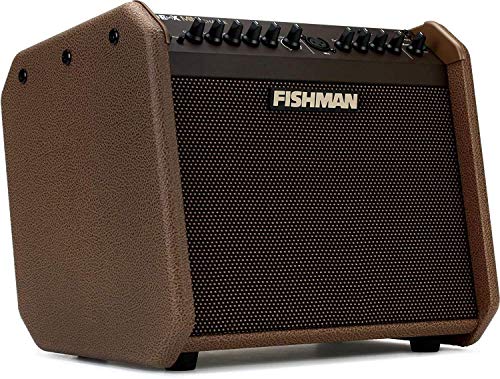
If you play acoustic guitar and your priority is tone fidelity above all else, the Fishman Loudbox Mini Charge is the amp built specifically for you. Fishman has spent decades engineering acoustic amplification, and the Loudbox Mini Charge is the battery-powered evolution of their best-loved combo amp. The 60-watt output from a 6.5-inch woofer and a tweeter delivers a clear, natural acoustic tone that doesn’t colour or compress the dynamic range of your instrument — something many general-purpose amps fail to achieve.
The two channels — one for instrument (with a quarter-inch and XLR combo jack) and one for a second instrument or microphone — each have independent volume, bass, and treble controls. The instrument channel also includes Fishman’s studio-quality chorus and reverb, which are among the best built-in effects available in any busking amp at this price point. The addition of Bluetooth connectivity allows you to stream a backing track from your phone and blend it with your live instrument signal — a game-changer for solo performers. It pairs beautifully with condenser microphones that need phantom power via its XLR input. If you’re wondering which mic to use with it, check out our guide to the best vocal mics under $200.
The built-in lithium-ion battery gives roughly 8 hours of playtime — more than enough for a full day of busking with breaks. At 12.5 lbs, it’s manageable but not as featherlight as the CUBE Street II.
PROS
- Exceptional acoustic tone fidelity — built specifically for acoustic instruments
- Studio-quality chorus and reverb effects
- Bluetooth for streaming backing tracks wirelessly
- XLR combo input with phantom power for condenser mics
- Built-in lithium-ion battery — ~8 hours runtime
CONS
- Not ideal for electric guitar — optimised for acoustic tones
- No built-in looper
INDEPENDENT REVIEW
4. Yamaha THR30IIA Wireless Acoustic Desktop Amp
🎒 BEST FOR ULTIMATE PORTABILITY

The Yamaha THR30IIA Wireless exists in its own category — a desktop amp that transitions seamlessly from your living room to the street. Yamaha essentially invented the desktop amp concept with the THR series, and the THR30IIA Wireless takes it further with a built-in rechargeable lithium-ion battery, a Line 6 wireless receiver (for cable-free guitar playing with a G10T transmitter, sold separately), and Bluetooth connectivity. At 8.8 lbs with a sleek, compact form factor, it’s one of the most packable 30-watt amps available.
The acoustic mic modeling is the real standout feature. Rather than just amplifying your pickup signal, the THR30IIA models the sound of boutique condenser, dynamic, and tube microphones — making your acoustic-electric guitar sound as if it were recorded in a professional studio. There’s also a voicing for nylon-string guitars and a flat mode for keyboards and other instruments. A dedicated Mic/Instrument input makes it ideal for singer-songwriters who need a combined vocal and guitar channel. Full Bluetooth connectivity allows for remote tone editing via the THR Remote app and audio playback from your phone. The trade-off is a battery life of around 5 hours — shorter than the CUBE Street II or the Fishman — making it better suited for shorter busking sessions or situations where you can top up mid-day.
PROS
- Stunning acoustic mic modelling for natural instrument reproduction
- Compact, lightweight desktop form factor — easy to pack and carry
- Built-in wireless receiver for cable-free guitar playing
- Bluetooth for app-based editing and backing track streaming
- USB audio interface for recording on the go
CONS
- ~5-hour battery life is shorter than most competitors
- Line 6 wireless transmitter (G10T) sold separately
INDEPENDENT REVIEW
5. Mackie ShowBox Battery-Powered All-in-One Live Performance Rig
🎛️ BEST ALL-IN-ONE PERFORMANCE RIG

For the busker who has outgrown a simple amp and wants a full performance rig in a single unit, the Mackie ShowBox is in a class of its own. This is a 400-watt, 6-channel PA system, mixer, and amp combined — battery-powered and designed from the ground up for street and small venue performance. The headline feature is the detachable breakaway mixer controller, which mounts directly to your microphone stand. This means you can adjust levels, effects, and routing from right beside your mic without ever walking back to the speaker — an absolutely brilliant solution for solo performers who need to manage their own sound live.
The six inputs handle a comprehensive performer’s setup: two XLR mic inputs with Onyx preamps (including phantom power for condenser mics), two hi-Z instrument inputs, an aux input, and Bluetooth streaming. Built-in effects include reverb, delay, chorus, distortion, and fuzz. There’s also an SD card slot for recording straight to a memory card, and a USB-C interface for recording and livestreaming directly to your phone or laptop. An outdoor mode optimises the EQ for open-air environments, and a built-in feedback eliminator keeps things clean at high volumes. For performers pairing the ShowBox with a quality XLR vocal microphone, the Onyx preamps are genuinely excellent. The trade-off for all this capability is weight (16.5 lbs) and a shorter battery life of around 5 hours at performance volumes.
PROS
- Detachable breakaway mixer — control levels from your mic stand
- Massive 400W output — easily cuts through busy street noise
- 6 inputs including phantom power for condenser mics
- SD card recording and USB-C livestream interface built-in
- Outdoor mode and feedback elimination optimised for busking
CONS
- Heaviest amp on this list at 16.5 lbs
- Battery life (~5 hours) is limited for full-day busking
INDEPENDENT REVIEW
6. Coolmusic BP80 Battery-Powered Acoustic Guitar Amplifier 100W
💰 BEST BUDGET BUSKING AMP

The Coolmusic BP80 is the most accessible entry point to professional-level busking performance. For a fraction of the cost of the Bose or Fishman, it delivers a genuinely impressive 100 watts of dynamic output from an 8-inch woofer and a 3-inch tweeter — a combination that can hold its own on busy streets. Six inputs make it extremely versatile: there’s a channel with an XLR/quarter-inch combo jack and 48V phantom power for condenser microphones, a second instrument channel, aux, and USB. A Bluetooth 5.0 connection allows you to stream backing tracks from your phone cleanly and reliably. The built-in three-band EQ on each channel gives you enough tonal control to dial in a good sound quickly.
The built-in lithium-ion battery delivers around 6 hours of runtime — solid enough for a full day out with a lunch break. The wooden cabinet construction adds durability and resonance at the cost of some weight (14.3 lbs). This amp won’t match the tonal sophistication of the Fishman Loudbox or the engineering elegance of the Bose, but for buskers who are just starting out or working on a tight budget, the BP80 provides power and flexibility that far exceeds its price tag. It also includes a headphone monitor output for silent practice at home — a thoughtful addition for anyone preparing new material before taking it to the street.
PROS
- Exceptional value — 100W output at a budget price
- 48V phantom power for condenser microphones
- Bluetooth 5.0 for clean wireless backing track streaming
- 6 inputs for versatile instrument and mic combinations
- Headphone output for silent at-home practice
CONS
- Sound quality is noticeably below premium-tier options
- Heavier wooden cabinet makes it less comfortable on long walks
INDEPENDENT REVIEW
Buyer’s Guide: How to Choose the Perfect Busking Amp
Battery Power: Lithium-Ion vs. AA Batteries
The single most important feature that separates a busking amp from a practice amp is battery power — without it, you’re anchored to a wall socket and your busking career is over before it starts. Two battery technologies dominate the market right now.
AA batteries (used by the Boss CUBE Street II) offer the practical advantage of being replaceable on the spot. If you drain your batteries mid-performance, you can pop into any corner shop and buy a fresh set in minutes. The CUBE Street II achieves an impressive 15 hours on 6 AA alkalines — far more than any lithium-ion competitor on this list. The downside is ongoing battery cost if you perform frequently.
Lithium-ion batteries (used by the Bose, Fishman, Yamaha, Mackie, and Coolmusic) are rechargeable, more environmentally friendly, and increasingly the standard in modern portable amps. They typically deliver between 5 and 11 hours on a single charge. The key trade-off is that when a lithium-ion battery depletes, you need a power source to recharge — there’s no quick fix on the street. As a general rule, aim for at least 6 hours of battery life to cover a full busking day comfortably.
Inputs and Channels
At a minimum, any busking amp worth using should have at least two independent channels: one for your instrument (quarter-inch jack) and one for your vocal microphone (XLR). If your mic is a condenser model, check that the amp provides 48V phantom power — not all do. For acoustic performers who loop, you’ll want to ensure one channel accepts your instrument’s pickup and another can take a mic signal simultaneously without bleed.
Bluetooth connectivity has moved from “nice to have” to “near-essential” for modern buskers. Being able to wirelessly stream a backing track from your phone to the amp’s aux mix — while you play and sing over it — lets a solo performer create a much fuller sound. Check out our guide to the best XLR vocal mics to ensure your microphone matches your amp’s input standard.
Wattage and Volume for the Street
Wattage is frequently misunderstood by beginners. Raw wattage isn’t the whole story — speaker efficiency and enclosure design matter just as much. The Bose S1 Pro+ produces a louder and more distributed sound than many 60-watt amps because of its acoustic engineering. That said, a rough practical guide is useful: 5–10 watts is workable in quiet parks and pedestrian areas; 30–60 watts covers typical city street environments; 100 watts or more is what you want for busy urban locations, markets, or semi-outdoor venues. Anything below 10 watts will struggle to project above general city noise and foot traffic.
Built-In Effects and Loopers
A built-in reverb is almost a hygiene requirement for any busking amp — dry, unaffected vocals and instruments sound flat and thin in the open air, where there’s no natural room reverb to fill the sound. Most amps on this list include at least basic reverb on each channel. Beyond reverb, a built-in looper is increasingly valuable for solo street performers. A looper lets you record a chord progression or rhythm guitar part live, then solo or sing over it on loop — essentially making a one-person band. The Boss CUBE Street II is the standout here, with a dedicated looper built in alongside chorus and delay. If you want additional effect processing beyond what an amp provides, pair it with an external reverb pedal via the effects loop where available.
Portability and Weight
Every busker eventually learns the same hard lesson: your amp needs to be something you can realistically carry alongside your instrument, a bag, and possibly a stand. Before you buy, honestly assess how you’ll be transporting your gear. If you’re taking public transport, a target weight of under 8 lbs is ideal — the Boss CUBE Street II at 5.5 lbs is exceptional in this regard. If you drive to your pitch, up to 15–20 lbs is manageable. Consider whether the amp has a carry handle, and whether you’ll also want to invest in a padded gig bag for protection during transit. A good gear checklist can help you plan your full busking setup before your first performance.
Frequently Asked Questions About Busking Amps
Can I use a regular guitar amp for busking?
You can use a standard guitar amp for busking only if you have a portable power station or access to a mains outlet at your pitch. Most traditional combo amps require a wall socket, which makes them impractical for street performance. A dedicated battery-powered busking amp — like those reviewed above — is the far better solution, giving you full freedom to set up anywhere without permits or infrastructure.
How loud does my busking amp need to be?
For quiet parks or pedestrian side streets, 10–20 watts may be sufficient. For typical busy city streets, aim for at least 30 watts. For markets or high-traffic urban areas, 60–100+ watts gives you the headroom to project comfortably without pushing the amp into distortion. Efficient speaker design matters as much as wattage — the Bose S1 Pro+ sounds louder and more even than many higher-wattage amps due to its acoustic engineering.
Do I need a permit or licence to use an amp while busking?
Busking laws vary significantly by city and by specific location within a city. Many major cities have designated zones where amplification is permitted freely or requires a licence from the local council or transport authority. Some cities restrict amplified busking on certain streets entirely. Always check local busking guidelines before setting up with an amp in a new location to avoid fines or having your equipment confiscated. If you’re a vocalist preparing for busking, our guide to the best throat lozenges for singers is also worth a read before your first outdoor gig.
What is the best busking amp for singer-songwriters?
Singer-songwriters who need to simultaneously amplify both an acoustic guitar and vocals are best served by the Boss CUBE Street II (maximum portability and battery life), the Fishman Loudbox Mini Charge (best acoustic tone quality), or the Bose S1 Pro+ (most professional and wide-coverage sound). All three feature independent channels for instrument and microphone, XLR inputs, and quality reverb effects.
Final Verdict
For the majority of buskers — whether you’re just starting out or performing regularly a few times a week — the Boss CUBE Street II is the best busking amp you can buy in 2026. Its 15-hour battery life, built-in looper, vocal harmony, and featherlight 5.5 lbs make it the most practical, well-rounded option available at its price point. It’s the amp that replaced the beloved Roland CUBE Street EX and then improved on it in every meaningful way.
If you’re a serious professional performer who plays multiple gigs per week and needs the absolute best sound coverage available, invest in the Bose S1 Pro+. The engineering behind its sound dispersion, ToneMatch technology, and build quality is simply on another level — it’s the amp you’ll use for years without ever wanting to upgrade. For acoustic guitarists who prioritise tonal fidelity above everything else, the Fishman Loudbox Mini Charge is the clear choice. And for buskers working on a tight budget who still need real power, the Coolmusic BP80 delivers surprising performance for its price.