The plugin world is full of synthesizers that promise something new and deliver something familiar. Another wavetable engine. Another FM redesign. Another sampled-everything library. Texture and atmosphere have always been the hardest thing to get right without leaning on the same tired sample packs. That gap is exactly where Modartt’s New Airteq lands, released September 15, 2026. It’s not a synthesizer. It’s not a sample library. It physically models air flowing through virtual pipes in real time — and the result sounds unlike anything else in your plugin folder. Verdict: genuinely original, with one real-world limitation you should know about before you buy.
What Is Airteq, Exactly?
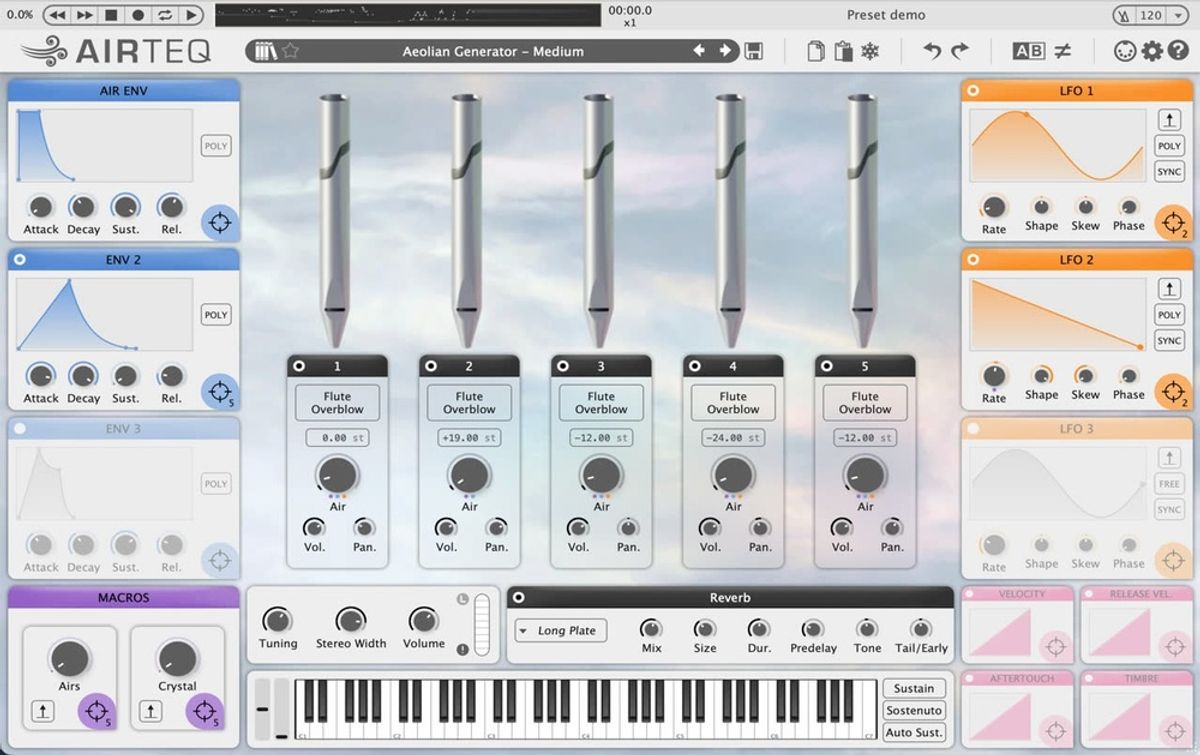
Think of it this way: a pipe organ makes sound by forcing air through pipes. Airteq takes that same physical principle and uses it as a synthesis engine instead of recreating a specific instrument. You’re not playing a flute or an organ. You’re shaping airflow through imaginary pipes that don’t exist in the real world — and the sounds that come out sit somewhere between cinematic texture, evolving pad, and breathing electronic sculpture.
That engine runs on Modartt’s proprietary Dynamic Aerophone Modeling (DAM) technology, built on years of research that also produced their acclaimed Pianoteq and Organteq instruments. This isn’t a side project — it’s years of R&D finally available to everyone.
Quick-Glance Specs
| Feature | Detail |
|---|---|
| Sound engine | Dynamic Aerophone Modeling (DAM) — no samples, no traditional synthesis |
| Pipe families | Flutes, Reeds, Mixtures — combine up to 5 per patch |
| Air responses | Overblow, Glissando, Steady Pitch (per pipe) |
| Modulation | 2 envelopes, 3 assignable LFOs, macro controls — modulate the source, not a filter |
| Expressivity | Full MPE, velocity, pitch bend, aftertouch, CCs, breath/wind controllers |
| Reverb | Built-in convolution reverb with selectable IRs, size, pre-delay, dry/wet |
| Presets | 170+ (pads, cinematic textures, organic sounds, rhythmic pulses) |
| Formats | VST3, AU, LV2, AAX + standalone |
| OS | macOS (Apple Silicon + Intel), Windows, Linux |
| Price | $99 / €99 — free trial available |
What Modartt Isn’t Telling You
The concept is brilliant. The execution has a few honest caveats worth knowing before checkout.
- Sound design depth is deliberately shallow. Early users on KVR noted that each pipe family exposes limited parameters — often just pitch, volume, and one editable control. If you want deep synthesis architecture with sixteen modulation slots and a visual routing matrix, this isn’t it. Airteq is intentional restraint, not an oversight — but know that going in.
- No NKS support at launch. If your studio runs Native Instruments Maschine or Komplete Kontrol keyboards, you won’t get browser integration or hardware light-up mapping on day one. That’s a friction point for a significant chunk of home studio producers.
- No microtonal tuning (MTS-ESP) support. Microtonalists take note — the MTS-ESP standard isn’t implemented yet. Modartt’s track record with post-launch updates is strong, so this will likely arrive, but it’s absent now.
- No iOS version at launch. Pianoteq runs on iPhone and iPad. Airteq doesn’t yet — and a commenter on Modartt’s own YouTube launch video immediately asked about it. The silence on that question speaks volumes.
How Does It Actually Compare?
Already own the SWAM instrument collection from Audio Modeling? You’re safe — these tools do completely different things. SWAM recreates real acoustic wind instruments with performance-driven physical modeling. You play them expressively, breath controller in hand. Airteq isn’t trying to sound like a real flute. It creates textures and atmospheres that real instruments can’t produce. They’re complementary, not competing.
If your go-to texture plugin is Vital running a wavetable with a reverb slapped on it, Airteq will genuinely surprise you — it breathes where a wavetable just oscillates.
For film and TV composers building studio setups around atmosphere and movement, the 170-plus preset library — stacked with evolving pads, cinematic textures, and rhythmic pulses — covers territory that sample libraries handle clumsily because they’re static by nature. Airteq moves. And if you pair it with an expressive MPE controller, the real-time airflow modulation becomes a performance instrument in its own right.
Who Should Actually Buy This?
✅ Buy This If…
- You score for film, TV, games, or trailers and need organic, evolving texture that samples can’t replicate
- You make ambient, experimental, or electronic music and want a breath-and-air character that wavetable synths can’t deliver
- You own a breath controller or MPE instrument — Airteq was built to reward expressive, continuous control
- You trust Modartt’s proven physical modeling pedigree (Pianoteq, Organteq) and want to explore where they go next
- You want to try before committing — the free trial removes the risk entirely
⛔ Skip This If…
- You need a workhorse synth with deep parameter editing and complex signal routing
- You already own SWAM instruments and want realistic acoustic wind — that’s a different tool for a different job
- Your workflow depends on NKS integration with Maschine or Komplete Kontrol hardware
- You’re a microtonalist who needs MTS-ESP tuning support today
- You mainly work inside a beat-based DAW workflow and rarely compose with texture or atmosphere
The Final Word
Modartt’s New Airteq is a confident, original instrument from a company that has never chased trends. It won’t replace your bread-and-butter synthesizer and it doesn’t try to. What it does — creating living, breathing, physically real textures from nothing but modeled airflow — nothing else at this price point does remotely as well. At $99 with a free trial, the risk of downloading it is zero. The only real question is whether you make the kind of music where organic movement and evolving atmosphere are tools you reach for. If you do, grab the trial and see how fast it earns a permanent place in your sessions.
💬 Does the idea of physically modeled air as a creative parameter excite you — or do you think $99 is too niche a tool for most producers? Drop your take in the comments below.