Software step sequencers have always had a groove problem. Standard DAW sequencers lock your notes to a rigid grid — and no matter how hard you try, the beats land flat. They just don’t breathe. That’s the gap Rapid Flow’s new miniGRID is designed to fill — and honestly? It nails it. At $29, this is the most opinionated groove tool to hit the plugin market this year, and bedroom producers should pay close attention.
What miniGRID Actually Does
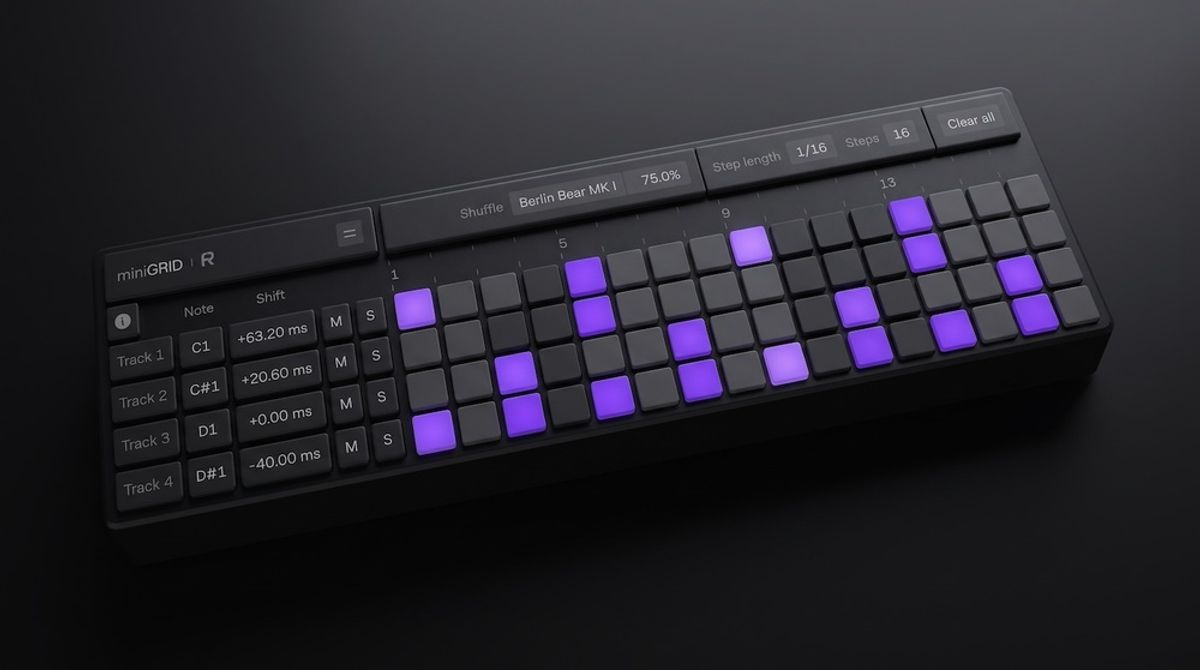
miniGRID is a 4-lane MIDI step sequencer plugin — available as VST3, AU, and AAX — that lets you build drum and instrument patterns while shifting the timing of each lane independently. Push your kick slightly early. Pull your snare back. Nudge your hi-hat by a fraction. Each lane controls its own timing to within 0.02 milliseconds.
That precision is what separates it from everything else at this price. This isn’t swing. This is micro-timing — the same way hardware drum machines from the 1980s made grooves feel human without trying.
The Spec Breakdown
| Feature | Detail |
| MIDI Lanes | 4 independent lanes |
| Timing Shift Per Lane | ±64 ms (0.02 ms resolution) |
| Max Steps Per Sequence | 32 steps with adjustable length |
| Shuffle Profiles | Roland TR-909, AKAI MPC60, E-MU SP-12, MPC 3000, Oberheim DMX, MFB Tanzbar, Linn LM-1 |
| MIDI Output | Routes into any compatible plugin or external hardware |
| DAW Compatibility | Ableton, Logic Pro, FL Studio, Cubase, Reaper, Pro Tools |
| Platform | macOS (Intel + Apple Silicon), Windows 10+, Linux (via Wine) |
| Price | $29 (lifetime license, 45-day free trial) |
What the Press Release Doesn’t Tell You
Here’s what Rapid Flow is quietly not leading with: miniGRID doesn’t generate sound. It sends MIDI notes to instruments you already own. That’s actually the right design decision — but first-time buyers need to know they’re getting a controller, not a drum machine replacement.
There’s also a real-world routing wrinkle. If your DAW quantizes incoming MIDI — some do by default — the timing shifts won’t work as expected. You’ll need to dig into your instrument settings to disable quantization. It’s a one-time fix, but it’s not mentioned prominently. New producers may hit this wall and assume the plugin is broken.
One more thing: the AU version only shows up in DAWs that support MIDI FX slots. Logic Pro handles this perfectly. If your DAW doesn’t, you’ll use VST3 instead — which works fine, just requires slightly more manual routing.
miniGRID makes cheap soft synths sound like they were triggered by a TR-909. That’s not nothing.
How It Compares to the Competition
If you already run a dedicated hardware sequencer with external MIDI clock — something like an Arturia BeatStep Pro — miniGRID won’t blow your mind. The workflow you have is probably more tactile and immediate.
But if you’re still dragging notes around in your DAW’s piano roll and wondering why your drum patterns sound lifeless, this is the upgrade you’ve been waiting for. It brings the groove intelligence of a $4,000 AKAI MPC 3000 into a $29 plugin. That’s the pitch, and it mostly delivers.
Native Instruments’ Groove Agent and similar tools offer shuffle features too — but they’re baked into specific instruments. miniGRID is instrument-agnostic. Plug it in front of any synth or drum plugin you already own and it works. That flexibility is genuinely valuable when you’re building out a home studio setup on a budget.
Who Should Actually Buy This?
✅ Buy This If…
- You produce hip-hop, house, or techno in-the-box and your beats feel robotic
- You’re a bedroom producer who wants hardware-style groove without buying hardware
- You use Ableton, Logic, FL Studio, Cubase, or Pro Tools
- You already own great drum samples or a synth but can’t seem to make patterns feel alive
- You want a 45-day free trial before committing a single dollar
❌ Skip This If…
- You already own a hardware sequencer with dedicated groove and timing controls
- You need an instrument — miniGRID produces zero audio on its own
- You produce styles where rigid, quantized timing is the point (certain EDM subgenres, for example)
- Your current MIDI controller setup already handles micro-timing externally
The Verdict
Rapid Flow’s new miniGRID is a focused, affordable answer to the groove problem that plagues in-the-box producers. It doesn’t try to be everything — and that restraint is exactly what makes it useful. Pair it with a solid set of studio headphones and a good monitoring chain, and you’ll hear the difference immediately the first time you push that snare back 20 milliseconds. This one is a genuine win for bedroom producers who want their music to feel as good as it sounds.
💬 Does miniGRID look like the groove tool you’ve been waiting for, or is there a hardware alternative you’d reach for first? Drop your thoughts in the comments below — we’d love to hear how you’re solving the groove problem in your own setup.
👉 Get miniGRID from Rapid Flow — $29 with a 45-day free trial