You’ve been there. It’s 1 a.m., headphones on, mix sounding massive — then you play it on your phone speaker and it falls apart completely. That’s the headphone mixing trap, and it’s plagued bedroom producers for years. Enter the LEWITT Space Replicator, a virtual acoustic spaces plugin that puts a professional mixing room directly inside your headphones. The verdict? This is the most practical solution to headphone mixing available right now — and part of it is completely free.
The Problem Every Headphone Mixer Knows
Mixing on headphones is convenient. No noisy neighbours, no need for acoustic treatment, total isolation. But here’s the problem — headphones lie to you. They create an unnaturally wide stereo image, exaggerate details, and can’t replicate what speakers actually do in a real room.
That’s why mix translation has always been the nightmare. You finish what sounds like a perfect mix on your cans, export it, hit play on a laptop speaker — and everything collapses. Decades of producers have worked around this with the “car test.” LEWITT just built the car test (and the club, and the studio) into a single plugin.
If you’re still learning the ropes of setting up your signal chain, check out our guide on the best audio interfaces for home studios before diving into plugins.
What Is the LEWITT Space Replicator?
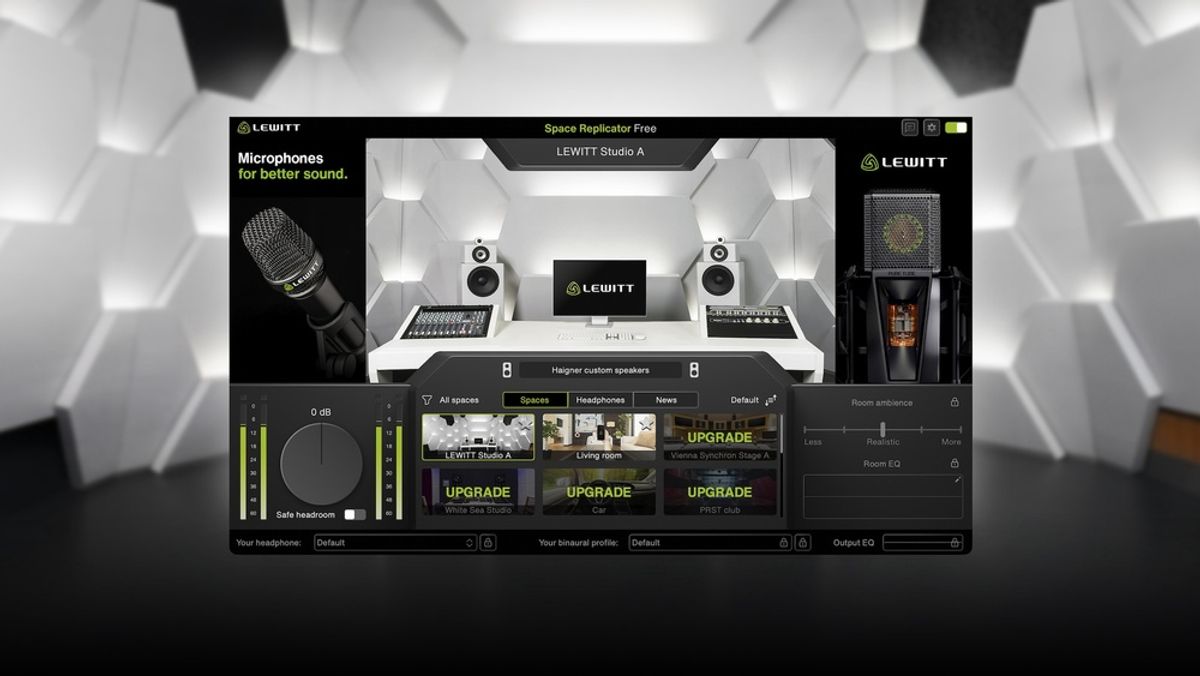
LEWITT — the Austrian company best known for its high-end microphones — developed a process to capture real acoustic spaces with extreme resolution and turn them into virtual environments. The Space Replicator renders these spaces through a personalised binaural profile (essentially a map of how YOUR ears and head shape sound) to create lifelike realism through any pair of headphones.
This is not a reverb plugin. It doesn’t add ambience to your mix. Instead, it simulates the spatial and directional cues of real-world speaker playback — using advanced HRTF (head-related transfer function) technology. Think of it as sitting in the sweet spot of a world-class studio, without leaving your bedroom.
Drop it on your master output bus in your DAW, run through a quick setup, and you’re mixing in LEWITT’s Studio A — or a car, or a nightclub, or a living room couch with a phone speaker. That’s the idea.
Specs at a Glance
| Feature | Free | Essential ($49) | Standard ($89) |
|---|---|---|---|
| Mixing Studios | 1 (Studio A) | 2 | 5 |
| Consumer Spaces | Living room | Kitchen + Car | Living room, kitchen, TV, car + more |
| Live Venues | None | 1 (Watergate club) | 2 (Watergate + PRST club) |
| Headphone Profiles | 800+ | 600+ | 800+ compensation curves |
| Headphone Emulations | None | 3 | 5 |
| Standalone App | ✓ | ✓ | ✓ |
| Plugin Formats | VST3, AU, AAX | VST3, AU, AAX | VST3, AU, AAX |
| OS Support | Win 10+ / macOS 12+ | Win 10+ / macOS 12+ | Win 10+ / macOS 12+ |
What They’re Not Telling You
The “Missing” Room Controls
Here’s what the press materials gloss over: you can’t adjust the amount of room ambience. Most competing plugins let you dial back the room effect to taste. Space Replicator locks you into a fixed sound for each room. Some users love this — it’s more like switching between real spaces rather than tweaking a knob. Others find it limiting.
The Learning Curve Is Real
Like any new monitoring tool, the Space Replicator takes time. One reviewer noted it took over six months to fully trust a competing system. You’ll need to spend hours learning how YOUR mixes translate through these rooms before you can confidently mix through them. That’s not a flaw — it’s just the reality of virtual monitoring.
Some Rooms Colour the Sound
The White Sea Studio space has been flagged by professional reviewers for some low-mid resonances that could push you toward unnecessary EQ moves. It’s a real-world imperfection of a real-world room — but it’s worth knowing before you base mixing decisions on it.
To be fair, LEWITT is actively listening to feedback and releasing regular updates. The 2.0 update already added standalone functionality, zero-latency performance, and new rooms. This is a brand that’s clearly committed to improving the product. Related: check out our breakdown of the best studio headphones for mixing to pair with this plugin.
How Does It Compare to the Competition?
The main players in this space are Slate VSX ($14.99/month subscription) and Waves Nx (~$35). Here’s the honest comparison:
If you’re currently using Slate VSX and love it — Space Replicator won’t change your life. Both use high-end HRTF modeling and achieve similar goals. The VSX system does require Slate’s specific headphones to work properly, which is a significant extra cost. Space Replicator works with any headphones you already own, with over 800 compensation profiles to calibrate whatever’s on your head.
If you’re still mixing raw on a pair of consumer headphones with no referencing tool at all — Space Replicator Free is the upgrade you need right now. It costs nothing, and it will immediately transform your ability to make mixing decisions you can trust. That’s a genuinely remarkable offer from LEWITT.
Waves Nx falls somewhere in the middle — it’s affordable, but its headphone compensation list is far smaller, and the HRTF profiling is less sophisticated. Space Replicator’s personalised binaural calibration process is a clear step up. Want to understand more about how to monitor your mixes effectively? Read our full guide on studio monitors vs. headphones for mixing.
Who Should Actually Buy This?
✅ Buy This If…
- You mix primarily on headphones in a bedroom or apartment
- You’re tired of mixes that don’t translate to other speakers
- You want a free starting point with real professional quality
- You already own a great pair of headphones and don’t want to buy dedicated cans just for a plugin (unlike VSX)
- You’re a content creator, podcaster, or producer who references across multiple playback environments
❌ Skip This If…
- You mix in a professionally treated room with calibrated studio monitors every day
- You’re already invested in the Slate VSX ecosystem and love it
- You need granular control over room ambience levels (this plugin doesn’t offer that yet)
- You want classic reference monitors like Yamaha NS-10s or Avantone Mixcubes emulated — they’re not in here
The Smartest Way to Start
Download the free version first. Spend a few weeks mixing through Studio A and checking your mixes against the living room setting. If it transforms your workflow — which it likely will — upgrading to Essential ($49) or Standard ($89) is a no-brainer. The upgrade path from Essential to Standard costs just another $50, so you can build into the full tool at your own pace.
Also worth noting: the standalone app means you don’t even need a DAW open to use it for reference listening. Put on a finished track, switch through the spaces, and hear exactly how it’ll sound in the real world. That alone makes it worth installing today. See how it pairs with your current setup by reading our picks for the best home studio gear for every budget.
Bottom Line on the LEWITT Space Replicator
The LEWITT Space Replicator is one of the most significant tools to hit the headphone mixing space in years — made all the more impressive because the core experience is free. LEWITT took their reputation for high-resolution audio capture and applied it to a new problem: giving bedroom producers the reference tools that professional studios take for granted. It’s not perfect — the lack of room blend controls and a few resonance issues with certain spaces keep it just shy of flawless. But at its price point, nothing else comes close to the value it delivers. Start free, hear the difference, and go from there.
Does the LEWITT Space Replicator look like a winner to you — or do you think there’s a better option for headphone mixing right now? Drop your thoughts in the comments below. We read every one.