Multiband compressors have always had a dirty little secret: you either compress everything between fixed crossover points, or you leave it alone. The result? Clunky workarounds, phase artifacts, and a lot of frustration for producers who just want to tame one problem frequency without nuking their whole mix. Parish Audio’s Parametric Compressor just changed that game entirely — and the verdict? This is one of the most genuinely original dynamics tools released this year.
What Makes This Different From a Regular Multiband Compressor?
Here’s the problem with traditional multiband compressors: they slice your audio signal into fixed adjacent bands — low, mid, high — and force compression to happen across those rigid divisions. Need to compress just a 3kHz harshness on a vocal without touching anything else? Tough luck. You’re getting band compression whether you like it or not.
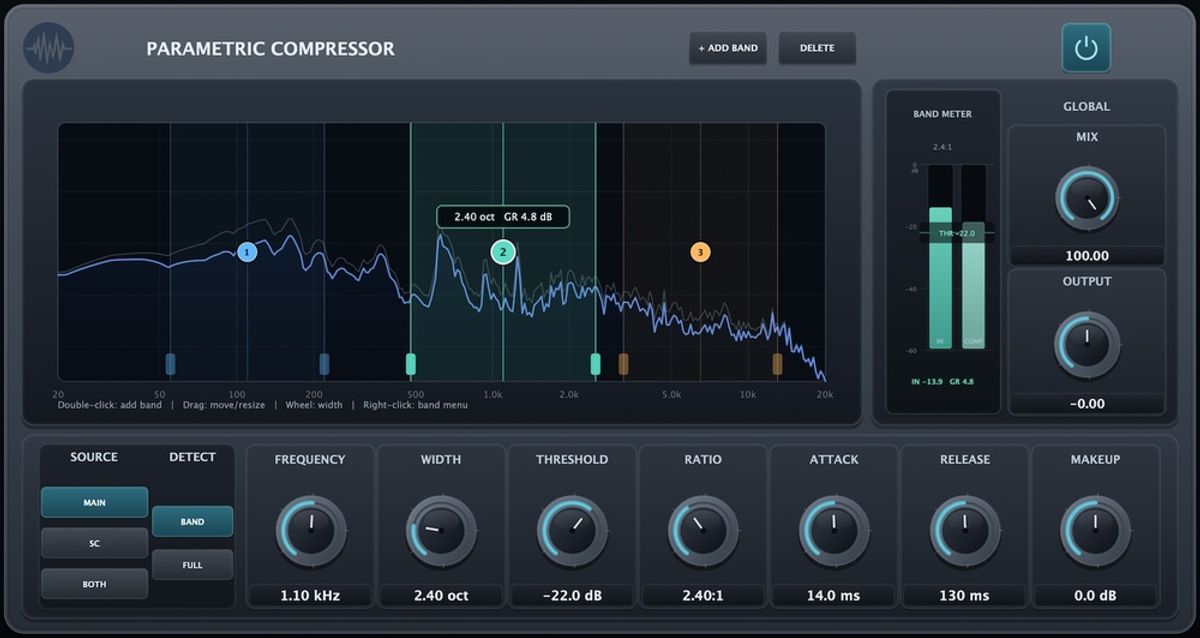
Parish Audio threw out that rulebook. With the Parametric Compressor, each compression band is completely independent. You place it exactly where you want it in the frequency spectrum, set its width (narrow and surgical, or wide and broad), and let it work. Bands can overlap freely. No fixed crossover points. No collateral damage.
It’s like having a parametric EQ, but instead of cutting or boosting frequencies — you’re compressing them. That’s a fundamentally different way of thinking about dynamics processing.
The Spec Breakdown
| Feature | Detail |
|---|---|
| Plugin Type | VST3 (Windows & Mac), AU (Mac) |
| Compression Bands | Up to 10 independent bands |
| Per-Band Controls | Frequency, Width, Threshold, Ratio, Attack, Release, Makeup |
| Detector Options | Main input, external sidechain, or both |
| Detection Mode | Band-limited or full-spectrum per band |
| Global Controls | Mix and Output |
| Interface | Interactive spectrum display |
| Launch Price | $34.97 (50% off, reg. $69.95 — sale ends Sept 1, 2026) |
What the Press Release Isn’t Telling You
Let’s be real for a second. The concept here is brilliant — but brilliance only counts if the execution holds up in a real session. A few things worth considering before you click buy:
- No AAX support yet. If you’re running Pro Tools as your main DAW, this one sits on the shelf for now. VST3 and AU only at launch.
- CPU load is an unknown. Ten simultaneous compression bands with independent detectors could get hungry fast on older machines. Parish Audio hasn’t published benchmarks.
- No preset library mentioned. For a concept this deep, an intelligent starting-point library could save beginners hours of learning curve.
- Brand pedigree is young. Parish Audio also sells the C11 Compressor and the E42 Equalizer, but they’re not FabFilter or Waves. Long-term plugin support is something to watch.
How Does It Stack Up Against the Competition?
The obvious comparison is FabFilter Pro-MB — the current gold standard in multiband compression at around $199. If you already own Pro-MB and love it, the Parametric Compressor isn’t going to revolutionize your workflow. Pro-MB has a polished UI, extensive preset library, and years of trust behind it.
But here’s where it gets interesting: Pro-MB still operates on crossover-based bands. The Parametric Compressor genuinely does something different — it doesn’t divide your signal at all. Think of it less as a multiband compressor and more as a dynamic EQ that actually compresses rather than EQs. The closest comparison is Trackspacer or a dynamic EQ like Neutron’s EQ with dynamic nodes — but with far more hands-on control per band.
If you’re still mixing on stock DAW compressors or a basic broadband comp, this plugin is a significant leap forward in what you can do with dynamics. Pair it with a solid pair of studio headphones and you’ll hear every micro-adjustment working in real time.
Who Should Actually Buy This?
✅ Buy This If You…
- Mix vocals and need surgical low-end or sibilance control without full-spectrum compression
- Produce electronic music and want to duck specific frequencies against a sidechain kick
- Are a bedroom producer ready to step beyond stock DAW dynamics tools
- Want a flexible dynamic EQ/comp hybrid under $35 right now
- Work in VST3 or AU environments (Logic, Ableton, Cubase, Studio One, Reaper)
❌ Skip This If You…
- Run Pro Tools exclusively (no AAX at launch)
- Already own FabFilter Pro-MB and are happy with it
- Need something with a built-in preset library to get started fast
- Are a total beginner who hasn’t yet mastered a standard single-band compressor
- Work on an older machine that may struggle with 10 simultaneous band detectors
Real-World Use Cases That Actually Make Sense
This plugin shines brightest in three specific scenarios that come up in every studio session:
Vocal De-essing Without a Dedicated De-esser
Drop a narrow band right in the 6–9kHz range, dial in a fast attack, moderate ratio, and let it catch the harshness only when the sibilance peaks. Everything else — the body, the air, the warmth — stays completely untouched.
Kick and Bass Separation
This is where the independent sidechain detector per band is genuinely powerful. Place a band on the bass in the 60–90Hz region, feed the kick drum signal as the detector source, and the bass ducks only in that frequency range when the kick hits. Your bass stays thick everywhere else. That’s frequency-selective sidechain ducking — a technique that used to require multiple plugin chains.
Mix Bus Correction
Ever get a mix back and notice the low-mids feel boxy and congested around 300–400Hz? Instead of reaching for a static EQ cut (which removes those frequencies permanently), place a wide Parametric Compressor band there and let it dynamically push down only when it gets too loud. Your mix stays open without sounding thin. If you’re still building your studio setup, this kind of plugin replaces what would cost thousands in analog hardware.
The Bottom Line on Parish Audio’s Parametric Compressor
At $34.97 during the launch sale, Parish Audio’s Parametric Compressor is a legitimate no-brainer for any producer who’s been wishing their dynamics tools were smarter. The concept is fresh, the execution looks solid, and the price removes almost every barrier to entry. Yes, there are open questions about CPU performance, preset depth, and long-term plugin support. But the underlying idea — place compression exactly where you want it, without dividing your signal — is one of those rare moments where a plugin makes you rethink how you approach an entire stage of the mixing process. Don’t sleep on this one.
Does the Parametric Compressor look like a genuine game-changer to you, or is the unproven brand name enough to make you wait for user reviews first? Drop your take in the comments — we read every one.
🔗 Get the Plugin: Parish Audio Parametric Compressor — Official Product Page