Cinematic synth plugins have been stuck in a compromise for years. You either get the warmth of classic hardware with none of the modern architecture, or a deep modular beast that eats your whole session just to dial in one patch. Something always gives. That ends now. The KeySolutions Sounds Traveler dropped on September 1, 2026 — and the verdict is immediate: this is the most expression-forward cinematic synthesizer to launch this year. No asterisks.
The Specs at a Glance
Don’t read the full press release. Here’s what actually matters:
| Feature | What You Need to Know |
|---|---|
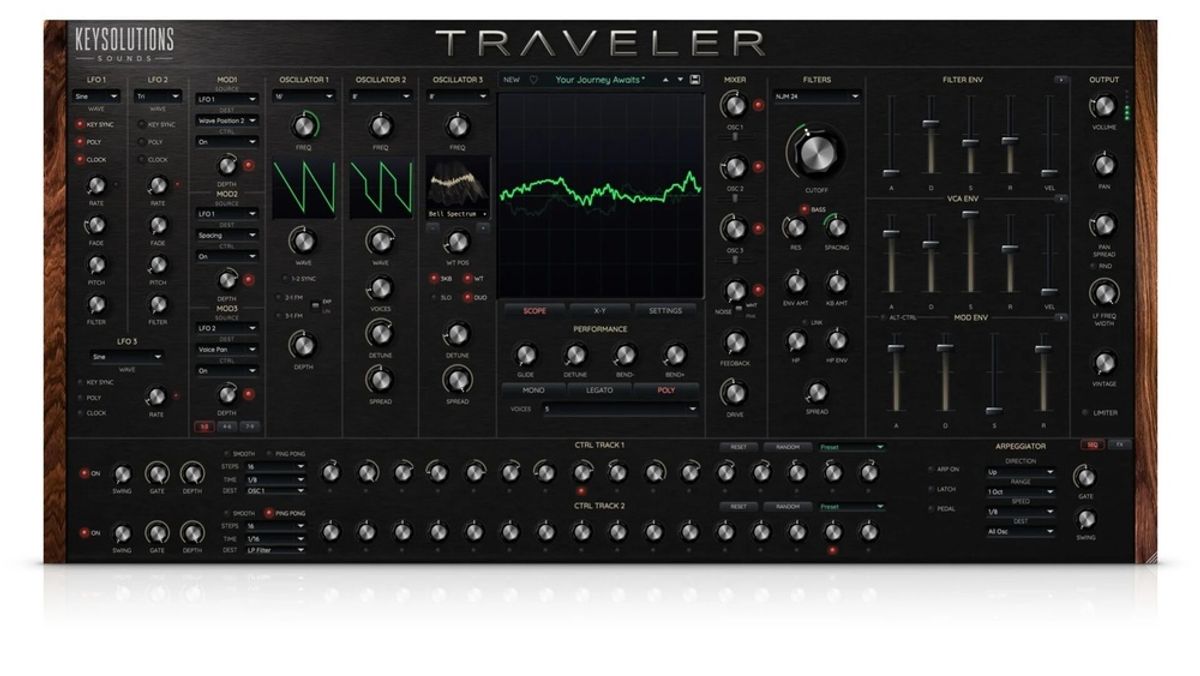
| Engine | Hybrid: virtual analog + 7-voice unison stack + 85-table wavetable oscillator |
| Filters | Ladder & Korg DW-8000 style, 6–24 dB/oct, dual/stereo topology with L/R spacing |
| Modulation | 3 polyphonic LFOs, 21 shapes, 21-slot matrix with 92 destinations |
| Envelopes | Switchable ADSR or extended ADBSSR with customizable stage curves |
| Sequencing | Dual 16-step control tracks + 20-mode arpeggiator (per-oscillator routing) |
| Presets | 400+ patches from Venus Theory, Scott McAuley, David Helpling & more |
| Bonus FX | KeyTIME (modulated delay) + KeySPACE (modulated reverb) — included free |
| Formats | VST3, AU, AAX, Standalone — macOS (Apple Silicon native) + Windows |
| Price | $99 intro (through Sep 30, 2026), then $149 regular |
What the Press Release Isn’t Saying
Mike Martin’s announcement leans heavily on “motion” and “expression.” Fair enough — Traveler’s immersive stereo architecture really does deliver on that promise. But two things didn’t make the headline:
No MPE support yet. If you’re playing a Roli Seaboard or any polyphonic expression controller, you’ll need to wait. Martin confirmed it’s on the roadmap, but it’s not here at launch. That’s a real gap for expressive keyboardists.
The UI is big. Cherry Audio-big. On a 27-inch display it’s gorgeous. On a 15-inch laptop screen, you’re going to feel it. Scaling it down makes the controls harder to read. Not a dealbreaker — just something you should know before you hit checkout.
“Nothing has to stay static. Sounds can evolve, pulse, change character, and move across the stereo field as you play. The destination isn’t fixed. The musician decides where the sound goes.”
— Mike Martin, KeySolutions Sounds
How Does It Stack Up?
The closest real competitor is u-he Zebra 3 — deep, motion-forward, cinematic in its bones. But Zebra 3 demands a learning curve like a cliff face. Traveler sits closer to a plug-and-play experience while still packing serious architecture underneath.
If you already own Arturia Pigments or Xfer Serum, Traveler won’t flip your entire workflow overnight. Those tools give you modulation depth and wavetable access. But if you’re still scoring your sessions off stock DAW instruments or a basic ROMpler, this is the upgrade you’ve been waiting for. The 400+ professional presets alone make it immediately usable — which is rare for a synth this deep.
Who Should Actually Buy This?
✅ Buy This If…
- You write cinematic, ambient, or trailer music
- You’re a composer working on indie games or film scores
- You love evolving, moving textures — not static patches
- You want a serious synth and still need a starting point of great presets
- You’re building out a home studio toolkit and don’t yet own a flagship soft synth
- You want to grab KeyTIME + KeySPACE FX ($98 value) for nothing extra
❌ Skip This If…
- You already run Arturia Pigments, Serum, or Zebra 3 and are happy
- You need full MPE support right now
- You produce pop, R&B, or hip-hop — this synth’s DNA is cinematic, not topline
- You do most of your work on a smaller laptop screen
- You’re not yet ready to invest in a plugin-first production workflow
At $99 through September 30, 2026 — with KeyTIME and KeySPACE thrown in free — the KeySolutions Sounds Traveler is one of the sharpest value propositions in the plugin market this year. A combined regular value of $247 for $99 is hard to argue with, and a 14-day free demo means you have zero excuse not to try it before you decide. The sound is there. The architecture is there. The presets are ready to go. What remains is just one question worth thinking about: does a cinematic synth built around motion and expression belong in your current setup, or is $149 (after the intro offer expires) more than you’d spend on a first-look plugin? Let us know in the comments below.